


Page 20 - History of War - Issue 29-16
P. 20
Frontline
             COMMANDERS BARBAROSSA

                                                                      OF


              After invasion began, military leaders on both sides rose
              to prominence and also fell from grace

              GEORGY ZHUKOV                        the con  ict, and was forced to sit back and
                                                   watch his nation slowly brought to its knees
              YEARS ACTIVE: 1915-1957              by a German hammer that crushed Russian
              ALLEGIANCE: SOVIET UNION             resistance at every encounter. By September,
                                                   Hitler was directing most of his forces in Russia
              When Hitler greenlit the invasion of the Soviet   towards Moscow, and Zhukov was soon sent
              Union in June 1941, Zhukov was one of the   back in the   eld to safeguard the city.
              high-ranking Russian commanders that signed   Zhukov’s impact on the defences of the city
              the of  cial military countermeasures to drive out   was immediate. His decision to recall Soviet
              the invaders and restore order to the fringes of   forces stationed in the Far East bolstered the
              the nation. The plan was to take a large force   resistance effort, with many hailing his tactical
              of Russian armour and infantry and encircle the   direction to get them to the city in record time
              German force, but despite superior numbers the   as a key in  uence on the siege’s eventual
              Soviets were routed by Axis forces.  outcome. The German attempt to overrun the
               In August 1941, when the Axis surrounded   city was hampered reinforcements pouring in
              Kiev and besieged the city, Zhukov had   and the end of the year, Zhukov organised a
              advised Stalin to evacuate the city rather than   counterattack on 6 December that drove the
              risk the lives of its inhabitants. Stalin refused   Axis out of the city.
              and when the city fell 600,000 men were
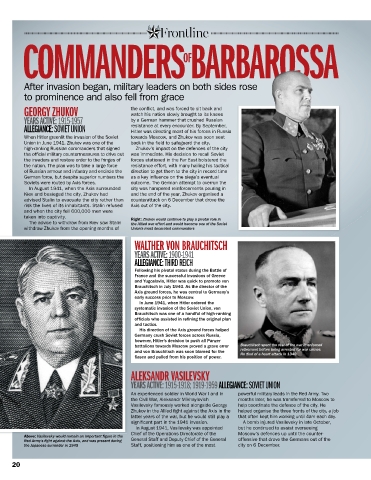
              taken into captivity.                Right: Zhukov would continue to play a pivotal role in
               The advice to withdraw from Kiev saw Stalin   the Allied war effort and would become one of the Soviet
              withdraw Zhukov from the opening months of   Union’s most decorated commanders

                                                     WALTHER VON BRAUCHITSCH
                                                     YEARS ACTIVE: 1900-1941
                                                     ALLEGIANCE: THIRD REICH
                                                     Following his pivotal status during the Battle of
                                                     France and the successful invasions of Greece
                                                     and Yugoslavia, Hitler was quick to promote von
                                                     Brauchitsch in July 1940. As the director of the
                                                     Axis ground forces, he was central to Germany’s
                                                     early success prior to Moscow.
                                                      In June 1941, when Hitler ordered the
                                                     systematic invasion of the Soviet Union, von
                                                     Brauchitsch was one of a handful of high-ranking
                                                     of  cials who assisted in re  ning the original plan
                                                     and tactics.
                                                      His direction of the Axis ground forces helped
                                                     Germany crush Soviet forces across Russia,
                                                     however, Hitler’s decision to push all Panzer
                                                     battalions towards Moscow proved a grave error   Brauchitsch spent the rest of the war in enforced
                                                     and von Brauchitsch was soon blamed for the   retirement before being arrested for war crimes.
                                                                                          He died of a heart attack in 1948
                                                       asco and pulled from his position of power.
                                                   ALEKSANDR VASILEVSKY

                                                   YEARS ACTIVE: 1915-1918; 1919-1959 ALLEGIANCE: SOVIET UNION
                                                   An experienced soldier in World War I and in   powerful military leads in the Red Army. Two
                                                   the Civil War, Aleksandr Mikhaylovich   months later, he was transferred to Moscow to
                                                   Vasilevsky famously worked alongside Georgy   help coordinate the defence of the city. He
                                                   Zhukov in the Allied   ght against the Axis in the   helped organise the three fronts of the city, a job
                                                   latter years of the war, but he would still play a   that often kept him working until 4am each day.
                                                   signi  cant part in the 1941 invasion.  A bomb injured Vasilevsky in late October,
                                                     In August 1941, Vasilevsky was appointed   but he continued to assist overseeing
                                                   Chief of the Operations Directorate of the   Moscow’s defences up until the counter-
              Above: Vasilevsky would remain an important   gure in the
              Red Army’s   ght against the Axis, and was present during   General Staff and Deputy Chief of the General   offensive that drove the Germans out of the
              the Japanese surrender in 1945       Staff, positioning him as one of the most   city on 6 December.

         20
         20


       020-021_HOW029_Heroes.indd   20                                                                                       04/05/2016   20:22

