


Page 22 - History of War - Issue 29-16
P. 22
Frontline
             DEFENCE   PAVLOV’S HOUSE

                                                 OF


              An under-strength                    1. THE GERMANS ATTACK AN            5. TANK DESTRUCTION FROM THE
              platoon of Soviet                    APARTMENT BUILDING                  ROOF

              soldiers defends                     On 23 September 1942, German soldiers attack   Pavlov discovers that a PTRS-41 anti-tank ri  e is very
                                                                                       effective against German tanks when it is mounted on the
                                                   a four-storey apartment block in the centre of
              Stalingrad’s house                   Stalingrad. The building is parallel to the west bank   roof. When tanks approach within 25 metres of the building,
                                                                                       their thin turret armour becomes exposed to anti-tank   re
                                                   of the Volga River and overlooks ‘9th January Square’,
              of horrors against                   a large public square that is named after the Bloody   from above but they are unable to elevate their weapons
                                                   Sunday Massacre of 1905.
                                                                                       high enough to retaliate. Pavlov reportedly destroys almost
              overwhelming                         2. SERGEANT PAVLOV SEIZES THE       a dozen tanks using this tactic.
              Wehrmacht numbers                    BUILDING                            6. INTERNAL LOGISTICS AND SUPPORT
                                                   When the apartment block is attacked, a platoon of   In order to communicate properly, Pavlov’s men breach
                   he Battle of Stalingrad is one of   Soviet soldiers from the 13th Guards Ri  e Division   the walls in the basement and upper   oors of the building
                   the most brutal battles in history   is ordered to take and defend it. They are led by   and also dig a communications trench to Soviet positions
              Tand, for most historians, it is the   Sergeant Yakov Pavlov, a low-ranking NCO who is   outside. Supplies are brought in via then trench or by boats
              crucial turning point of World War II. The   serving as the acting platoon commander as the   crossing the Volga, despite German air raids and shelling.
              Nazi attempt to take the strategic city of   unit’s lieutenant and senior sergeants have all been
              Stalingrad on the Volga River turned into an   killed and wounded. The assault on the building is   7. A HARSH EXISTENCE
              apocalyptic bloodbath. It resulted in huge   successful, although, only four men out of a 30-man   Despite the creation of the communications trench, the
              casualties and led to the eventual retreat   platoon survive the assault.   soldiers (and civilians who live in the basement) constantly
              and defeat of the Axis armies in Russia.                                 suffer from a shortage of food and especially water. There
              There were countless acts of heroism in the   3. PAVLOV STRIKES STRATEGIC   are no beds and the soldiers try to sleep on insulation wool
              battle but one of the most famous is the   GOLD                          torn off pipes.
              dogged, two-month-long Russian resistance   Pavlov surveys the situation and   nds the house is
              at a place called, ‘Pavlov’s House’, a forti  ed   strategically well placed for a defence. It is positioned   8. A RELENTLESS BOMBARDMENT
              apartment block in the centre of the city.  on a cross street and gives the defenders a clear line   The Germans continually shoot at the building day and night
              “THE NAZI ATTEMPT TO                 of sight for one kilometre to the north, south and   but each time soldiers or tanks cross the square to close in
                                                                                       Pavlov’s men in  ict a hail of machine gun and anti-tank   re
                                                   west of the city. After two days he is reinforced and
              TAKE THE STRATEGIC CITY              resupplied, bringing his unit up to under-strength   from the basement, windows and roof top, in  icting large
                                                   number of 25 men.
                                                                                       casualties and forcing the Germans to retreat.
              OF STALINGRAD ON THE                 4. DIGGING IN                       9. A GRIM TACTIC?
              VOLGA RIVER TURNED                   Joseph Stalin issues Order Number 227 to the troops   By mid-November Pavlov’s men reputedly use the lulls in
                                                                                         ghting to run out and kick over-heaped piles of German
                                                   in Stalingrad, “Not one step back.” Pavlov takes this
              INTO AN APOCALYPTIC                  to heart and orders the building to be surrounded with   corpses so that they are not used as cover for the next
                                                                                       round of attackers. Whatever the truth, the defenders hold
                                                   four layers of barbed wire and mine  elds. He also sets
              BLOODBATH”                           up machine gun posts in every available window facing   out until they are relieved by Soviet counterattacks on 25
                                                   the square as well as anti-tank ri  es and mortars.
                                                                                       November 1942.
               THE CASUALTIES OF STALINGRAD


               THE SOVIET VICTORY IN THE CAUCASUS TURNED
               THE TIDE OF WWII BUT AT A HORRENDOUS PRICE
               FOR BOTH SIDES
               The Battle of Stalingrad ended at the end of January and early February
               1943, almost exactly ten years to the day that Adolf Hitler had come to power
               in Germany in 1933. He had envisaged a Third Reich that would last for a
               thousand years but after Stalingrad that dream sharply evaporated. The reason
               for this was the massive casualties incurred by the Germans during the battle.
               The Wehrmacht’s Sixth Army had originally been comprised of 285,000 soldiers.
               Of these men 165,000 had been killed and 29,000 had been wounded and
               evacuated. That left 91,000 men who were taken prisoner by the Russians
               despite Hitler’s refusal to allow the men to surrender. Most of these prisoners
               would not survive Soviet captivity. It is estimated that only 5,000 German troops
               escaped the carnage.
                 The Russian casualties were even worse, with possibly one million fatalities,
               including nearly all the men that Stalin had committed to early stage of the
               battle. However, the Soviet Union could replace these enormous losses, whereas
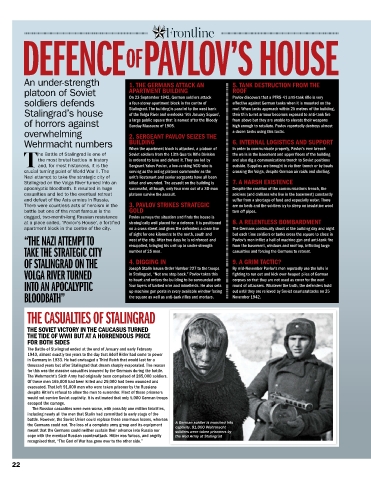
               the Germans could not. The loss of a complete army group and its equipment   A German soldier is marched into
                                                                   captivity. 91,000 Wehrmacht
               meant that the Germans could neither sustain their advance into Russia nor   soldiers were taken prisoners by
               cope with the eventual Russian counterattack. Hitler was furious, and angrily   the Red Army at Stalingrad
               recognised that, “The God of War has gone over to the other side.”


         22


       022-023_HOW029_Famous_Operation.indd   22                                                                             04/05/2016   20:34

