


Page 24 - History of War - Issue 29-16
P. 24
Frontline
                                ANATOMY OF THE
                                                                  P
                                                                                     NZE
                                                                           A
                                                                           A
                              U
                       T
                                         RM
                                         RM
             S S       T      U                                   P                  NZE                                     I
             STURMPANZER I
                                                                                                                 R
                                                                                                                 R
                                                                                                                             I


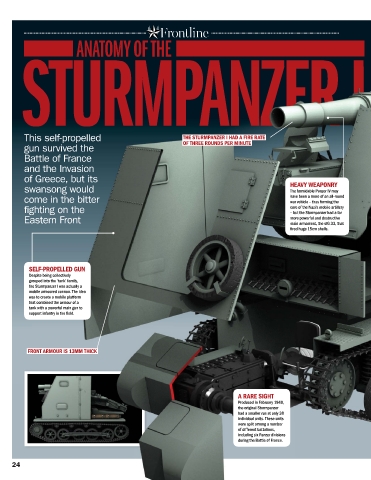
              T h i s  s el f - p r o p el l e d                      THE STURMPANZER I HAD A FIRE RATE
              This self-propelled
              gun survived the
              g u n  s u r v iv ed  t h e                             OF THREE ROUNDS PER MINUTE
                        o
                              an
                             r
                         f
                           F
                a
                   t

              B
              Battle of France
                    le
                                  c
                  t
                                    e
                     h
                                   o
                                    n

                              asi
                       e
                          I
                           nv
                    t
              a
                 d
              and the Invasion
                n
                            , b
                                  t i
              o
                          e
              of Greece, but its

                                u
                     e
                                     t
                    r
                                      s
                       ec
                f G
                                o
               w
                                    d

                                  ul
                       o
                         n
                    ns
                  a
                           g
              swansong would                                                                               HEAVY WEAPONRY
              s
                              w
                                                                                                           The formidable Panzer IV may
              come in the bitter                                                                           have been a more of an all-round
              come in the bitter
                                                                                                           war vehicle – thus forming the
                ghting on the                                                                              core of the Nazi’s mobile artillery
                ghting on the
                                                                                                           – but the Sturmpanzer had a far
              Eastern Front
              Eastern Front                                                                                more powerful and destructive
                                                                                                           main armament, the sIG 33, that
                                                                                                             red huge 15cm shells.
               SELF-PROPELLED GUN
               Despite being collectively
               grouped into the ‘tank’ family,
               the Sturmpanzer I was actually a
               mobile armoured cannon. The idea
               was to create a mobile platform
               that combined the armour of a
               tank with a powerful main gun to
               support infantry in the   eld.
               FRONT ARMOUR IS 13MM THICK
                                                                                         A RARE SIGHT
                                                                                         Produced in February 1940,
                                                                                         the original Sturmpanzer
                                                                                         had a smaller run at only 38
                                                                                         individual units. These units
                                                                                         were split among a number
                                                                                         of different battalions,
                                                                                         including six Panzer divisions
                                                                                         during the Battle of France.
         24
         24
       024-025_HOW029_Anatomy.indd   24                                                                                      04/05/2016   20:36

