


Page 64 - History of War - Issue 29-16
P. 64
TE LAWRENCE

              10,000 rails were torn up. Lawrence intended
              to keep the Hejaz Railway, “just in working                                                       Lawrence on his
              order, but only just,” enough to distract the                                                     Brough Superior
                                                                                                                SS100 which he
              Ottomans from the huge advance of the                                                             named George V
              Egyptian Expeditionary Force under General
              Edmund Allenby.
               Allenby was one of the best generals of the
              war and captured Jerusalem in December 1917,
              becoming the   rst European commander to
              take the city since the Crusades. Lawrence,
              who was a passionate medievalist, entered
              the city with Allenby on foot in British uniform
              saying, “For me it was the most memorable
              moment of the war, the one which, for historical
              reasons, made a stronger appeal than anything
              on Earth.”
              The road to Damascus
              Jerusalem was followed by Lawrence’s only
              pitched-battle victory of the campaign, at
              the Battle of Ta  la in late January 1918.
              600 Arabs had advanced on Ta  la but their
              presence alerted 1,000 Ottomans of the 48th
              Division, who marched to   ght the rebels. A
              tactical retreat was preferable, but that meant
              exposing the villagers of Ta  la to Turkish
              retribution. Faisal’s brother Zeid was ostensibly
              in command but Lawrence took the initiative by
              forming the rebels on a ridge outside the town
              that blocked the Ottoman path.

                        THE ROLLS-ROYCE ARMOURED CAR


                                                                                  LAWRENCE PIONEERED THE USE OF ARMOURED
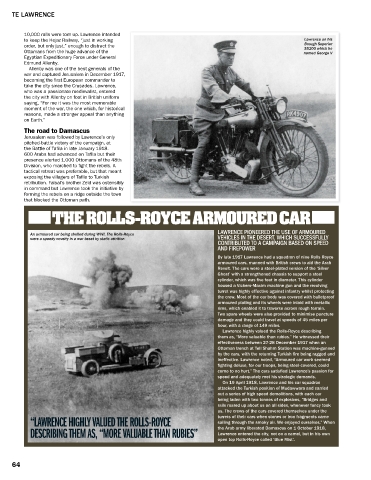
                An armoured car being shelled during WWI. The Rolls-Royce
                were a speedy novelty in a war beset by static attrition          VEHICLES IN THE DESERT, WHICH SUCCESSFULLY
                                                                                  CONTRIBUTED TO A CAMPAIGN BASED ON SPEED
                                                                                  AND FIREPOWER
                                                                                  By late 1917 Lawrence had a squadron of nine Rolls Royce
                                                                                  armoured cars, manned with British crews to aid the Arab
                                                                                  Revolt. The cars were a steel-plated version of the ‘Silver
                                                                                  Ghost’ with a strengthened chassis to support a steel
                                                                                  cylinder, which was   ve feet in diameter. This cylinder
                                                                                  housed a Vickers-Maxim machine gun and the revolving
                                                                                  turret was highly effective against infantry whilst protecting
                                                                                  the crew. Most of the car body was covered with bulletproof
                                                                                  armoured plating and its wheels were inlaid with metallic
                                                                                  rims, which enabled it to traverse across rough terrain.
                                                                                  Two spare wheels were also provided to minimise puncture
                                                                                  damage and they could travel at speeds of 45 miles per
                                                                                  hour, with a range of 149 miles.
                                                                                   Lawrence highly valued the Rolls-Royce describing
                                                                                  them as, “More valuable than rubies.” He witnessed their
                                                                                  effectiveness between 27-28 December 1917 when an
                                                                                  Ottoman trench at Tell Shahm Station was machine-gunned
                                                                                  by the cars, with the returning Turkish   re being ragged and
                                                                                  ineffective. Lawrence noted, “Armoured car work seemed
                                                                                    ghting deluxe, for our troops, being steel-covered, could
                                                                                  come to no hurt.” The cars satis  ed Lawrence’s passion for
                                                                                  speed and adequately met his strategic demands.
                                                                                   On 19 April 1918, Lawrence and his car squadron
                                                                                  attacked the Turkish position of Mudawwara and carried
                                                                                  out a series of high speed demolitions, with each car
                                                                                  being laden with two tonnes of explosives, “Bridges and
                                                                                  rails roared up about us on all sides, whenever fancy took
                                                                                  us. The crews of the cars covered themselves under the
                “LAWRENCE HIGHLY VALUED THE ROLLS-ROYCE                           turrets of their cars when stones or iron fragments came
                                                                                  sailing through the smoky air. We enjoyed ourselves.” When
                DESCRIBING THEM AS, “MORE VALUABLE THAN RUBIES”                   the Arab army liberated Damascus on 1 October 1918,
                                                                                  Lawrence entered the city, not on a camel, but in his own
                                                                                  open top Rolls-Royce called ‘Blue Mist’.


         64


       058-065_HOW029_Lawrence_of_Arabia.indd   64                                                                           04/05/2016   18:35

