


Page 69 - History of War - Issue 29-16
P. 69
UH-1H IROQUOIS ‘HUEY’

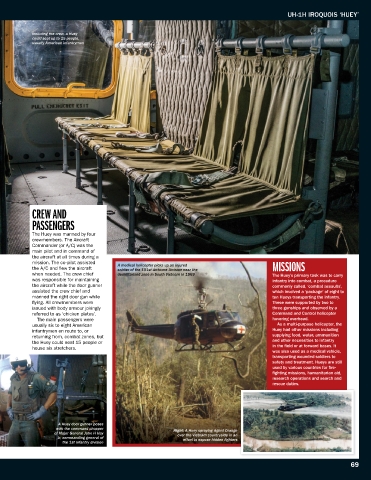
                 Including the crew, a Huey
                 could seat up to 15 people,
                 usually American infantrymen


                 CREW AND
                 PASSENGERS

                 The Huey was manned by four
                 crewmembers. The Aircraft
                 Commander (or A/C) was the
                 main pilot and in command of
                 the aircraft at all times during a
                 mission. The co-pilot assisted   A medical helicopter picks up an injured
                 the A/C and   ew the aircraft   soldier of the 101st Airborne Division near the     MISSIONS
                 when needed. The crew chief   demilitarised zone in South Vietnam in 1969           The Huey’s primary task was to carry
                 was responsible for maintaining                                                     infantry into combat, a procedure
                 the aircraft while the door gunner                                                  commonly called, ‘combat assaults’,
                 assisted the crew chief and                                                         which involved a ‘package’ of eight to
                 manned the right door gun while                                                     ten Hueys transporting the infantry.
                   ying. All crewmembers were                                                        These were supported by two to
                 issued with body armour jokingly                                                    three gunships and observed by a
                 referred to as ‘chicken plates’.                                                    Command and Control helicopter
                  The main passengers were                                                           hovering overhead.
                 usually six to eight American                                                         As a multi-purpose helicopter, the
                 infantrymen en route to, or                                                         Huey had other missions including
                 returning from, combat zones, but                                                   supplying food, water, ammunition
                 the Huey could seat 15 people or                                                    and other necessities to infantry
                 house six stretchers.                                                               in the   eld or at forward bases. It
                                                                                                     was also used as a medical vehicle,
                                                                                                     transporting wounded soldiers to
                                                                                                     safety and treatment. Hueys are still
                                                                                                     used by various countries for   re-
                                                                                                       ghting missions, humanitarian aid,
                                                                                                     research operations and search and
                                                                                                     rescue duties.


                          A Huey door gunner poses
                         with the command chopper                 Right: A Huey spraying Agent Orange
                        of Major General John H Hay                 over the Vietnam countryside in an
                         Jr, commanding general of                    effort to expose hidden   ghters
                           the 1st infantry division


                                                                                                                                69


       066-071_HOW029_Operators_Handbook.indd   69                                                                           04/05/2016   19:23

