


Page 77 - History of War - Issue 29-16
P. 77
HELL SALVADOR
littered the foothills of El Playon, the majestic
volcano and favourite dumping ground used by
death squads.
It’s best to explain the civil war as dominoes.
The rst was the coup in 1979 that kept a
military junta in power. This was the same
junta whose soldiers opened re on unarmed
protesters on the steps of San Salvador’s
Metropolitan Cathedral on 9 May 1979. Next
was the assassination of Archbishop Óscar
Romero by gunmen linked to the right-wing
ARENA party founded by Roberto D’Aubuisson,
a former army of cer trained by the US. The
third was the rape and murder of four American
missionaries by a Salvadoran death squad. The
last to fall was the FMLN’s brazen attempt at a
Tet Offensive-esque power grab before Ronald
Reagan became the president of the United
States in January 1981.
The Reagan administration considered the
crisis in El Salvador another front of potential
Soviet Communist encroachment. The loss
of Nicaragua was bad enough and Honduras
was teetering as well. The solution was a sort
of Vietnam redux, smaller in scale but just as
devastating, with an accompanying ood of
M16’s and Huey gunships.
US largesse meant a billion dollars of aid
was funnelled to the Salvadoran military –
money that paid for the whole war – complete
with Marines and Green Berets as advisers. It
was only in the mid-1990s that citations and
medals were awarded to the mysterious El
Salvador veterans, whose numbers could have
reached 5,000, for their clandestine work in a
hot and dangerous place.
The 1985 documentary, In the Name of the
People, shot by four American lmmakers,
with narration by actor Martin Sheen,
captures the other side of the coin in
the FMLN. The struggle is a desperate
one for the comrades – who appreciate
every bit of token support from the Communist
Bloc – and even from kind-hearted idealists
like the American doctor Charlie Clements, a
Vietnam veteran who was disillusioned by US
foreign policy. Near the lm’s disheartening
climax a shipment of B-40 rocket launchers
arrives in the FMLN camp and the guerrillas
affectionately name them ‘Cubans.’
Killing without reason
As early as the mid-1980s the leaders of
El Salvador’s right-wing government were
contemplating a negotiated settlement with the
FMLN, whose attacks on San Salvador were
getting harder to repulse. The guerrillas were no
longer ragtag peasants and had well-defended
logistical networks in Nicaragua and Honduras
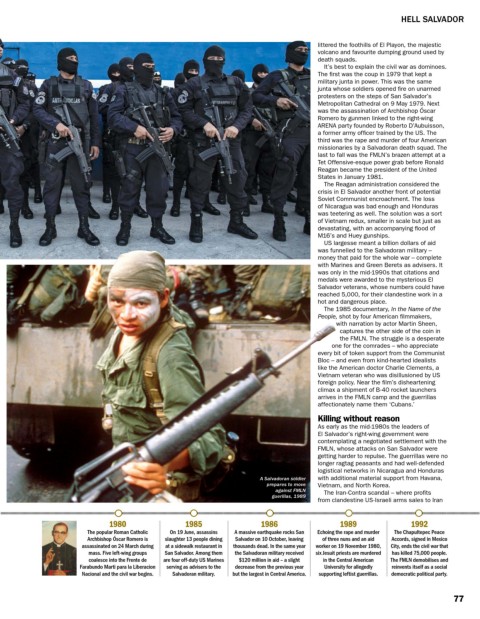
A Salvadoran soldier with additional material support from Havana,
prepares to move Vietnam, and North Korea.
against FMLN The Iran-Contra scandal – where pro ts
guerillas, 1989
from clandestine US-Israeli arms sales to Iran
1980 1985 1986 1989 1992
The popular Roman Catholic On 19 June, assassins A massive earthquake rocks San Echoing the rape and murder The Chapultepec Peace
Archbishop Óscar Romero is slaughter 13 people dining Salvador on 10 October, leaving of three nuns and an aid Accords, signed in Mexico
assassinated on 24 March during at a sidewalk restaurant in thousands dead. In the same year worker on 19 November 1980, City, ends the civil war that
mass. Five left-wing groups San Salvador. Among them the Salvadoran military received six Jesuit priests are murdered has killed 75,000 people.
coalesce into the Frente de are four off-duty US Marines $120 million in aid – a slight in the Central American The FMLN demobilises and
Farabundo Marti para la Liberacion serving as advisers to the decrease from the previous year University for allegedly reinvents itself as a social
Nacional and the civil war begins. Salvadoran military. but the largest in Central America. supporting leftist guerrillas. democratic political party.
77
074-079_HOW029_Briefing_El Salvador.indd 77 04/05/2016 16:22

