


Page 80 - History of War - Issue 29-16
P. 80
egypt’s


           struggle


             canaan

                                            for


                    In the Late Bronze Age, Egypt became the
                dominating superpower of the Middle East, but
               its rule over the southern Levant was challenged

              time and again. The two major battles of Megiddo
               and Kadesh would seal the fate of the region for
                                     centuries to come


                                             WORDS MARCEL SERR
                       he rise of the   rst civilisations in   breeding, but also continued access to the
                       the Middle East in the Bronze Age   woods that were needed for construction. For
                       was the beginning of organised   Egypt, this meant access to the cedars of the
                       warfare, accompanied by brilliant   region now known as Lebanon. It was for this
              T inventions that enhanced strategy,   reason, among others, that the area became
              tactics, and, of course, weaponry. In the fourth   highly sought after by neighbouring powers.
              millennium BCE, tin was added to copper in   Two centuries earlier, in the 17th century
              order to produce a harder alloy – bronze. In time  BCE, Egypt had been conquered by the
              this would come to mean that war was a much   Hyksos. For over 100 years these conquerors
              more serious, and deadly business.   introduced new weapons – like the horse-
               Besides the invention of the composite   drawn chariot, heavy bronze swords and the
              bow towards the end of the third millennium   composite bow – to the Egyptian people.
              BCE, one of the most signi  cant military   Ironically, with the help of these new arms, the
              innovations of that time was the war chariot,   Egyptians   nally overwhelmed the Hyksos and
              which had possibly already been introduced by   founded the New Kingdom (c. 1570 BCE) that
              the Sumerians around 3000 BCE. By the 15th   became the most powerful player in the Middle
              century BCE the Egyptians had developed the   East, dominating the southern Levant.
              chariot to become the deadliest weapon of its
              time. However, production and maintenance   The rise of Thutmose III
              required not only expensive training and horse   When Pharaoh Thutmose II died in around 1479
                                                   BCE, his son, also named Thutmose was still
                                                   too young to rule. This left Hatshepsut, the
                                                   young man’s stepmother, to reign in his stead
                                                   and later declared herself pharaoh. While she
                                                   did most of the ruling, Thutmose became head
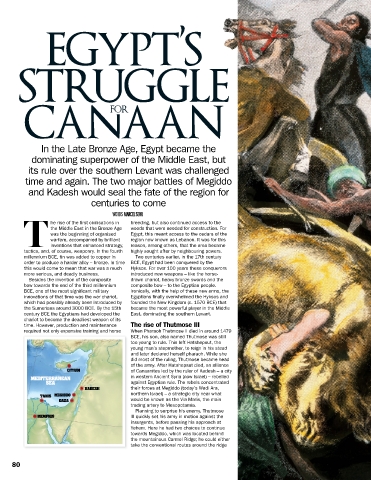
                                                   of the army. After Hatshepsut died, an alliance
                             CITIUM                of Canaanites led by the ruler of Kadesh – a city
                MEDITERRANEAN                      in western Ancient Syria (now Israel) – rebelled
                     SEA                           against Egyptian rule. The rebels concentrated
                                   KADESH          their forces at Megiddo (today’s Wadi Ara,
                   TANIS  MEGIDDO                  northern Israel) – a strategic city near what
                          GAZA                     would be known as the Via Maris, the main
                                                   trading artery to Mesopotamia.
                                                     Planning to surprise his enemy, Thutmose
                  MEMPHIS                          III quickly set his army in motion against the
                                                   insurgents, before pausing his approach at
                                                   Yehem. Here he had two choices to continue
                                                   towards Megiddo, which was located behind
                                                   the mountainous Carmel Ridge; he could either
                                                   take the conventional routes around the ridge


         80


       080-082_HOW029_Egypts_struggle.indd   80                                                                              04/05/2016   16:23

