


Page 78 - History of War - Issue 29-16
P. 78
BRIEFING

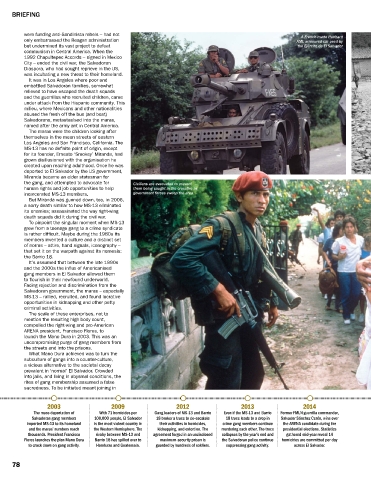
              were funding anti-Sandinista rebels – had not                                                    A French-made Panhard
              only embarrassed the Reagan administration                                                     AML armoured car used by
              but undermined its vast project to defeat                                                       the Ejército de El Salvador
              communism in Central America. When the
              1992 Chapultepec Accords – signed in Mexico
              City – ended the civil war, the Salvadoran
              Diaspora, who had sought reprieve in the US,
              was incubating a new threat to their homeland.
               It was in Los Angeles where poor and
              embattled Salvadoran families, somewhat
              relieved to have escaped the death squads
              and the guerrillas who recruited children, came
              under attack from the Hispanic community. This
              milieu, where Mexicans and other nationalities
              abused the fresh off the bus (and boat)
              Salvadorans, metastasised into the maras,
              named after the army ant in Central America.
               The maras were the children looking after
              themselves in the mean streets of eastern
              Los Angeles and San Francisco, California. The
              MS-13 has no de  nite point of origin, except
              for its founder, Ernesto ‘Smokey’ Miranda, had
              grown disillusioned with the organisation he
              created upon reaching adulthood. Once he was
              deported to El Salvador by the US government,
              Miranda became an elder statesman for
              the gang, and attempted to advocate for   Civilians are evacuated to prevent
              human rights and job opportunities to help   them being caught in the cross  re as
              incarcerated MS-13 members.           government forces sweep the area
               But Miranda was gunned down, too, in 2006,
              a sorry death similar to how MS-13 eliminated
              its enemies; assassinated the way right-wing
              death squads did it during the civil war.
               To pinpoint the singular moment when MS-13
              grew from a teenage gang to a crime syndicate
              is rather dif  cult. Maybe during the 1980s its
              members invented a culture and a distinct set
              of norms – attire, hand signals, iconography –
              that set it on the warpath against its nemesis:
              the Barrio 18.
               It’s assumed that between the late 1990s
              and the 2000s the in  ux of Americanised
              gang members in El Salvador allowed them
              to   ourish in their newfound underworld.
              Facing rejection and discrimination from the
              Salvadoran government, the maras – especially
              MS-13 – rallied, recruited, and found lucrative
              opportunities in kidnapping and other petty
              criminal activities.
               The scale of these enterprises, not to
              mention the resulting high body count,
              compelled the right-wing and pro-American
              ARENA president, Francisco Flores, to
              launch the Mano Dura in 2003. This was an
              uncompromising purge of gang members from
              the streets and into the prisons.
               What Mano Dura achieved was to turn the
              subculture of gangs into a counter-culture,
              a vicious alternative to the societal decay
              prevalent in ‘normal’ El Salvador. Crowded
              into jails, and living in abysmal conditions, the
              rites of gang membership assumed a false
              sacredness. To be initiated meant joining in


                      2003                  2009                   2012                   2013                  2014
                 The mass deportation of   With 71 homicides per   Gang leaders of MS-13 and Barrio   Even if the MS-13 and Barrio   Former FMLN guerrilla commander,
                Salvadoran gang members   100,000 people, El Salvador   18 broker a truce to de-escalate   18 truce leads to a drop in   Salvador Sánchez Cerén, wins over
               imported MS-13 to its homeland   is the most violent country in   their activities in homicides,   crime gang members continue   the ARENA candidate during the
               and the maras’ numbers reach   the Western Hemisphere. The   kidnapping, and extortion. The   murdering each other. The truce   presidential elections. Statistics
               thousands. President Francisco   rivalry between MS-13 and   agreement forged in an undisclosed   collapses by the year’s end and   gathered mid-year reveal 14
              Flores launches the plan Mano Dura   Barrio 18 has spilled over to   maximum-security prison is   the Salvadoran police continue   homicides are committed per day
               to crack down on gang activity.  Honduras and Guatemala.  guarded by hundreds of soldiers.  suppressing gang activity.  across El Salvador.


         78


       074-079_HOW029_Briefing_El Salvador.indd   78                                                                         04/05/2016   16:22

