


Page 87 - History of War - Issue 29-16
P. 87
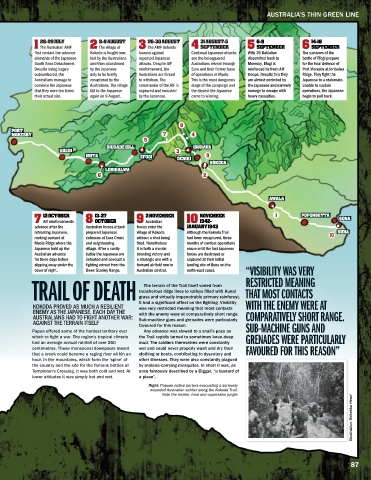
AUSTRALIA’S THIN GREEN LINE
1 2 h 8 e A 2 u 9 J r a U l i L Y M F 2 8-9 AUGUST 3 26- A 3 MF A U f GUS T 4 SEPTEMBER 5 SEPTEMBER 6 SEPTEMBER
A
31 AUGUST-5
31
9 A
-
6-9
8
GUS
T
U
0
-
5
26-30 AUGUST
-
28-29 JULY
G
U
14-16
S
U
T
4 SEPTEMBER
g
T
T
h
a
l
a
h
e
e
s
t
2 The village of
e o
ds
d
T
e v
en
1 The Australian AMF
i
3 The AMF defends
l
n A
f
a
t
t
rst contact the advance Kokoda is fought over, Isurava against Continual Japanese attacks With 39 Battalion The survivors of the
rst contact the advance
t
an
e
o
n
Isurava against
e
Kokoda is fought over,
s
al
n
ap
u
J
i
C
s
c
k
a
lost by the Australians
elements of the Japanese
elements of the Japanese lost by the Australians repeated Japanese see the beleaguered dispatched back to battle of Efogi prepare
see the beleaguered
repeated Japanese
attacks. Despite AIF
Australians retreat through
and then abandoned
South Seas Detachment. and then abandoned attacks. Despite AIF Australians retreat through Moresby, Efogi is for the nal defence of
South Seas Detachment.
reinforcement, the
Eora and their former base
by the Japanese
Despite being hugely
Despite being hugely by the Japanese reinforcement, the Eora and their former base reinforced by fresh AIF Port Moresby at Ioribaiwa
outnumbered, the only to be brie y Australians are forced of operations at Myola. troops. Despite this they Ridge. They ght the
Australians are forced
outnumbered, the
only to be brie y
of operations at Myola.
Australians manage to recaptured by the to withdraw. The This is the most dangerous are almost encircled by Japanese to a stalemate.
Australians manage to
This is the most dangerous
recaptured by the
to withdraw. The
convince the Japanese Australians. The village commander of the AIF is stage of the campaign and the Japanese and narrowly Unable to sustain
commander of the AIF is
Australians. The village
convince the Japanese
stage of the campaign and
the closest the Japanese
that they were ten times
captured and executed
that they were ten times fall to the Japanese captured and executed the closest the Japanese manage to escape with operations, the Japanese
fall to the Japanese
came to winning.
their actual size. again on 9 August. by the Japanese. came to winning. heavy casualties. begin to pull back.
their actual size.
again on 9 August.
by the Japanese.
8
PORT
MORESBY 7 4
5
B R IG A DE H I L L I ISURAVA
BRIGADE HILL
R
AV
U
S
A
BER
UBERI I 3
U
I IMITA EFOGI D E N IKI 9
I
TA
M
DENIKI
KO
DA
KOKODA
KO
AL
B
O
A
RI
L
LORIBALWA
W
6 2
AWALA
AW A L A
E
POPON
D
T
A
T
12 OCTOBER 13-27 2 NOVEMBER NOVEMBER 1 POPONDETTA GONA
G
O
NA
7 AIF reinforcements 8 OCTOBER 9 Australian 10 1942-
advance after the Australian forces attack forces enter the JANUARY 1943
NA
U
B
retreating Japanese, prepared Japanese village of Kokoda Although the Kokoda Trail 10 BUNA
making contact at defences at Eora Creek without a shot being had been recaptured, three
Myola Ridge where the and neighbouring red. Nonetheless months of combat operations
Japanese hold up the village. After a costly it is both a morale ensue until the last Japanese
Australian advance battle the Japanese are boosting victory and forces are destroyed or
for three days before defeated and conduct a a strategic one with a captured at their initial
slipping away under the ghting retreat from the forward air eld now in landing site of Buna on the
cover of night. Owen Stanley Range. Australian control. north-east coast. “VISIBILITY WAS VERY
RESTRICTED MEANING
TRAIL OF DEATH grass and virtually impenetrable primary rainforest. THAT MOST CONTACTS
The terrain of the Trail itself varied from
treacherous ridge lines to valleys lled with Kunai
It had a signi cant affect on the ghting. Visibility
K O K O D A P R O V E D A S M U C H A RE S I L I E N T was very restricted meaning that most contacts WITH THE ENEMY WERE AT
KOKODA PROVED AS MUCH A RESILIENT
ENEMY AS THE JAPANESE. EACH DAY THE
ENEMY AS THE JAPANESE. EACH DAY THE with the enemy were at comparatively short range.
AUSTRALIANS HAD TO FIGHT ANOTHER WAR:
AUSTRALIANS HAD TO FIGHT ANOTHER WAR: Sub-machine guns and grenades were particularly COMPARATIVELY SHORT RANGE.
AGAINST THE TERRAIN ITSELF favoured for this reason.
AGAINST THE TERRAIN ITSELF
Any advance was slowed to a snail’s pace as SUB-MACHINE GUNS AND
o
d s
e h
t
o
e
e
r
r
Papua offered some of the hardest territory over
v
f t
e o
y o
m
P
h
a
r
r
r
p
e
s
t t
d
e
e
i
a
r
f
a o
u
f
a
e
t
i
g
g
h
o
’
s t
which to ght a war. The region’s tropical climate the Trail rapidly turned to sometimes knee-deep GRENADES WERE PARTICULARLY
n
w
e
a
r
h t
h
t a w
. T
h
e r
o
c
i
r
i
i
p
m
l
l c
c
a
o
a
l r
u
n
r
n av
a
f
5
n
i
n
e
a
d a
f o
a
r 2
v
l
h had an average annual rainfall of over 250 mud. The soldiers themselves were constantly
g
e a
e
0
a
l o
wet and could never properly wash and dry their
centimetres. These monsoonal downpours meant clothing or boots, contributing to dysentery and FAVOURED FOR THIS REASON”
centimetres. These monsoonal downpours meant
that a creek could become a raging river within an
that a creek could become a raging river within an
n
i
r
i
u
n
. I
e m
o
n
’ o
e
a
n t
t
r
h f
m t
h
c
h
o
hour. In the mountains, which form the ‘spine’ of other illnesses. They were also constantly plagued
hour. In the mountains, which form the ‘spine’ of
h
, w
p
s
h
i
o
e ‘
f
s
u
the country and the site for the famous battles at
the country and the site for the famous battles at by malaria-carrying mosquitos. In short it was, as
Templeton’s Crossing, it was both cold and wet. At
Templeton’s Crossing, it was both cold and wet. At once famously described by a Digger, “a bastard of
lower altitudes it was simply hot and wet.
lower altitudes it was simply hot and wet. a place”.
s
l
y
ou
s
er
i
u
a
a
p
a
t
n
n
i
g
Right: Papuan native porters evacuating a seriously
R
:
P
h
t
i
c
u
v
a
ing
a
a
t
or
t
p
v
e
e
s
er
wounded Australian soldier along the Kokoda Trail.
wounded Australian soldier along the Kokoda Trail.
Note the incline, mud and oppressive jungle
Note the incline, mud and oppressive jungle
Illustration: Rebekka Hearl
87
084-091_HOW029_Kokoda_Trail.indd 87 04/05/2016 18:43

