


Page 88 - History of War - Issue 29-16
P. 88
AUSTRALIA’S THIN GREEN LINE
e
h
b
i
t
m
n
p
i
g
e
d
s l
o
v
u
, e
n
k
s
a
n
g
a
i
ll
e a
u
a
i
s
v
y
l
a
a
c
d
t
a
t
e b
f
. I
t
the battle of Myola Ridge, eventually anking
h
n
l
a
i
a R
n
l
a
i
d
n
o
e o
u
l
a
y
g a
f M
t G
massive amphibious landing at Guadalcanal. If the battle of Myola Ridge, eventually anking A Papuan orderly
m
s
J
r
e
e
n
h
r
me
p
a
e
e
a
acr
a
d
the Americans were able to capture the airstrip,
n
e
r
t
s
t
a
ac
e
o
three Japanese detachments arrayed across
the Americans were able to capture the airstrip, three Japanese detachments arrayed across helps a wounded
t
d
ss
y
h
they would have a stepping stone against the the Trail. Australian soldier on
the Trail.
they would have a stepping stone against the
u
d f
r
h
u
s
a
a
e
li
t
s
s p
chain of Japanese held islands in the Paci c. T The Australian troops pushed forward Christmas Day, 1942
d
r
a
The Australian troops pushed forward
r
o
o
p
n t
h
r
e A
chain of Japanese held islands in the Paci c.
w
o
For the Japanese, the advance against the
steadily, sending out reconnaissance parties
For the Japanese, the advance against the s t e a d il y , s e n d i n g o u t r e c o n n a i s s a n c e p a r t i e s
steadily, sending out reconnaissance parties
Australians in Papua was taking too long
Australians in Papua was taking too long to scout out the Japanese defences. As one
to scout out the Japanese defences. As one
against stiff resistance and commanders were
against stiff resistance and commanders were veteran described it: “I’ll never forget the rst
veteran described it: “I’ll never forget the rst
nervous about over-committing to the capture
nervous about over-committing to the capture time I was forward scout… You were very lucky
time I was forward scout… You were very lucky
of Moresby, especially while the US Marines to survive, so you had a certain time [working
of Moresby, especially while the US Marines
to survive, so you had a certain time [working
as a scout], then somebody else took over,
fought back a major Japanese counter-attack
fought back a major Japanese counter-attack as a scout], then somebody else took over,
on Guadalcanal. The enemy forces had nite
see. And you couldn’t do anything, you only
on Guadalcanal. The enemy forces had nite see. And you couldn’t do anything, you only
walked up the track. You were the bloke they
resources (they had set out from Buna along walked up the track. You were the bloke they
resources (they had set out from Buna along
the Trail with enough rations and water for only
were going to shoot at. Then you’d know there
the Trail with enough rations and water for only were going to shoot at. Then you’d know there
were Japs there.”
12 days) and, with an already dangerously over- were Japs there.”
12 days) and, with an already dangerously over-
extended supply train, the decision was made
The withdrawing Japanese 144 Regiment
extended supply train, the decision was made The withdrawing Japanese 144 Regiment
to focus on defeating the Marine landings.
had been ordered to retreat to Eora Creek and
to focus on defeating the Marine landings. had been ordered to retreat to Eora Creek and
Late in September, the Japanese were
construct defensive positions on the eastern
Late in September, the Japanese were construct defensive positions on the eastern
forced to postpone their ambitions toward Port
slopes of the Track, south of Eora. These
forced to postpone their ambitions toward Port slopes of the Track, south of Eora. These
Moresby and instead were forced to conduct
Moresby and instead were forced to conduct overlooked the natural barrier of the creek. The
overlooked the natural barrier of the creek. The
a withdrawal themselves, north along the Trail
Japanese infantry were well supported by their
a withdrawal themselves, north along the Trail Japanese infantry were well supported by their
back to the village of Eora. As no Japanese own artillery, positioned to re down the incline
own artillery, positioned to re down the incline
back to the village of Eora. As no Japanese
upon advancing Australian forces at a highly
term existed for ‘retreat’, the order instead upon advancing Australian forces at a highly
term existed for ‘retreat’, the order instead
called for an ‘advance to the rear’. The delaying
lethal angle.
called for an ‘advance to the rear’. The delaying lethal angle.
tactics employed by the Australians had paid Despite their well-sited positions and on-call
tactics employed by the Australians had paid
Despite their well-sited positions and on-call
off, slowing their enemy’s advance until it was artillery support, the Japanese defenders
off, slowing their enemy’s advance until it was
artillery support, the Japanese defenders
also faced a number of dif cult challenges
no longer a viable option. The Diggers had also faced a number of dif cult challenges
no longer a viable option. The Diggers had
of their own. Their commander had been
turned the tide – now they were the attackers. of their own. Their commander had been
turned the tide – now they were the attackers.
Fresh AIF troops advanced back up the Trail,
Fresh AIF troops advanced back up the Trail, recently replaced as he was required to attend
recently replaced as he was required to attend
reaching Menari without contacting the enemy. a promotion exam back in Japan, precisely
reaching Menari without contacting the enemy.
a promotion exam back in Japan, precisely
On 12 October, the advancing Australians
On 12 October, the advancing Australians when the now demoralised troops needed
when the now demoralised troops needed
continuity and a steady hand. They were also
made contact with the retreating Japanese at
made contact with the retreating Japanese at continuity and a steady hand. They were also
“A WEEK-LONG BATTLE ENSUED AT TEMPLETON’S CROSSING
AND INTO EORA ITSELF. MORE THAN 50 DIGGERS WERE KILLED
IN ACTION AND OVER 130 WERE WOUNDED DURING THIS
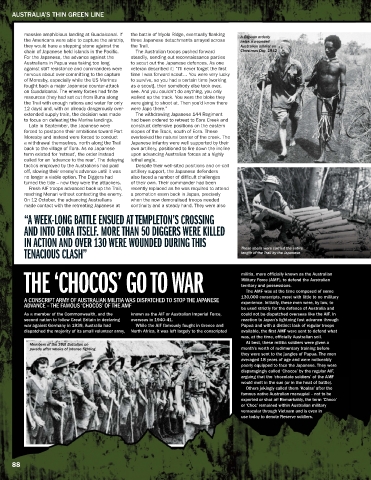
TENACIOUS CLASH” These shells were carried the entire
length of the Trail by the Japanese
’ G
O
R
E
‘
A
THE ‘CHOCOS’ GO TO WAR militia, more of cially known as the Australian
O W
T
C
H
C
S
O T
O
H
Military Force (AMF), to defend the Australian
territory and possessions.
The AMF was at the time composed of some
130,000 conscripts, most with little to no military
A CONSCRIPT ARMY OF AUSTRALIAN MILITIA WAS DISPATCHED TO STOP THE JAPANESE
A C O N S C RI P T A R M Y O F A U S T R A L I A N M I L I T I A W A S DIS P A T C H E D T O S T O P T H E J A P A N E S E
ADVANCE – THE FAMOUS ‘CHOCOS’ OF THE AMF
ADVANCE – THE FAMOUS ‘CHOCOS’ OF THE AMF experience. Initially, these men were, by law, to
be used strictly for the defence of Australia and
m
o
o
A
As a member of the Commonwealth, and the known as the AIF or Australian Imperial Force, could not be dispatched overseas like the AIF. In
s a m
nw
m
n
b
h
h
t
m
d t
e
l
a
, a
e
e C
r o
h
f t
e
e
r
e
a
l
o
w G
t B
a
i
n i
r
i
t
l
o
n
d n
s second nation to follow Great Britain in declaring overseas in 1940-41. reaction to Japan’s lightning fast advance through
e
c
a
n t
o f
o
t
i
o
g
n
c
i
n d
l
e
a
r
a
n
9
n 1
e
n
d
a
a
m
g
r
i
y i
w
l
i
s
t
r
a
war against Germany in 1939, Australia had While the AIF famously fought in Greece and Papua and with a distinct lack of regular troops
s
a
9
3
r a
u
a h
, A
t G
e
h
i
s
y
d dispatched the majority of its small volunteer army, North Africa, it was left largely to the conscripted available, the rst AMF were sent to defend what
,
t
r
c
p
m
a
t
s s
u
t
f i
n
l
l v
o
m
l
a
y o
e
a
j
e m
d t
r a
h
i
t
r
o
e
was, at the time, of cially Australian soil.
At best, these militia soldiers were given a
Members of the 39th Battalion on
parade after weeks of intense ghting month’s worth of rudimentary training before
they were sent to the jungles of Papua. The men
averaged 18 years of age and were noticeably
poorly equipped to face the Japanese. They were
disparagingly called ‘Chocos’ by the regular AIF,
arguing that the ‘chocolate soldiers’ of the AMF
would melt in the sun (or in the heat of battle).
Others jokingly called them ‘Koalas’ after the
famous native Australian marsupial – not to be
exported or shot at! Remarkably, the term ‘Choco’
or ‘Choc’ remained within Australian military
vernacular through Vietnam and is even in
use today to denote Reserve soldiers.
88
084-091_HOW029_Kokoda_Trail.indd 88 04/05/2016 18:45

