


Page 91 - History of War - Issue 29-16
P. 91
AUSTRALIA’S THIN GREEN LINE
U
E
S
P C
LO
“THEY ARE BEAUTS AT GETTING if I can see them. I don’t know how they get up UP CLOSE
those coconut trees. I can’t climb them stripped,
UP THE COCONUT TREES AND yet they can take a machine gun up one.”
Despite this ferocious opposition, disease, the
& PERSONAL
SNIPING. THEY SEEM TO BE lack of food and water and the jungle itself, the & PERSONAL
Australians were triumphant. Kokoda became
EVERYWHERE, AND I’LL BE the rst time the Japanese were soundly
defeated and, it was felt at the time by a grateful
BLOWED IF I CAN SEE THEM” nation, the end of the spectre of invasion. THE SMALL ARMS EACH SIDE WIELDED
S E
E W
D
H
T
D
M
R
I
E
H S
E S
M
D
L
E
A
L
A
L A
C
I
General Sir William Slim commented after
IN THE CRAMPED JUNGLE CONDITIONS
the war: “It was the Australians… who broke IN THE CRAMPED JUNGLE CONDITIONS
S
ANE
S
J
AP
ARM
E
had so gallantly and bravely raced towards us the spell of Japanese invincibility on land and JAPANESE ARMS
waving his sword, you know, extraordinary sight, in icted on that arrogant army its rst defeat.”
E 3
I
P
Y
8 R
E
F
T
L
you wouldn’t think you would see it in this 1942 Japanese casualties are unknown but are TYPE 38 RIFLE
CLIP CAPACITY: 5 RATE OF FIRE: 15 RPM
war would you?” believed to number in the thousands. Over CLIP CAPACITY: 5 RATE OF FIRE: 15 RPM
In common with the later island-hopping 1,600 Australian servicemen were wounded in C o m p a r e d t o m o s t J a p a n e s e s m a l l a r m s , t h e b o l t
Compared to most Japanese small arms, the bolt
campaigns in the Paci c, Kokoda was an action on the Trail, and 625 made the ultimate action Type 38 was a decent service ri e. Its 6.5mm
n T
y
i
t
. I
s 6
o
r
e
v
s a d
i
n
t s
e
e
c
e 3
e
p
a
c
e r
i
8 w
t
5
.
c
m
m
a
exceptionally vicious operation in which no sacri ce in combat. They lost many more to r round produced less recoil and muzzle ash than the
n t
o
d
e
o
r
c
o
a
h
d l
s
e
u
z
e
z
h
u
e
e
l
s r
c
a
d p
s
i
l a
u
h t
n
n
d m
quarter was given by either side. Tales of malaria, dysentery and dengue fever. The standard Australian .303. .
3
sta
st
n
l
u
3
d
.
rd
a
r
n
i
a
a
A
0
Japanese atrocities only fuelled the ‘shoot former CO of the famous 39th Battalion, the
rst, ask questions later’ nature of the ght, late Lieutenant Colonel Ralph Honner, summed
where the taking of prisoners was an unusual up the feelings of many when he said: “They
occurrence. The Japanese also proved a skilful died so young. They missed so much. They
opponent, devising tactics to match the unique gave up so much; their dreams; their loved
TYPE 92 MEDIUM MACHINE GUN
terrain. Another Digger wrote: “They are beauts ones; they laid down their lives so that their T Y P E 9 2 M E D I U M M A C H I N E G U N
CLIP CAPACITY: 30 RATE OF FIRE: 450 RPM
at getting up the coconut trees and sniping. friends might live. Greater love hath no man CLIP CAPACITY: 30 RATE OF FIRE: 450 RPM
They seem to be everywhere, and I’ll be blowed than this.” The Japanese medium machine gun, the Type 92 was
d
T
a
p
n
h
p
e 9
a
e J
u
e T
y
s
n
i
e
c
h
a
s
h
u
2 w
e g
e
e m
m m
i
a
n
, t
o
u
s
g
e
0 r
an unusual design fed from 30 round stripper clips.
o
.
m 3
a
n f
r
d f
n
s
a
l d
r
p
e
r c
u
d s
e
s
t
u
n
i
p
p
i
l
n u
i
c
t t
s
i
r t
d
s t
e
n
h
i
g
g
a
s n
o
h
k
o
e W
r
k
D
e
n
c
d i
Diggers nicknamed it the Woodpecker thanks to its
p
m
e
t
a
e
o i
k
slow and steady rate of re.
slow and steady rate of re.
AUSTRALIAN ARMS
AUSTRALIAN ARMS
H
BREN LIGHT MACHINE GUN
N
I
R
T M
E
U
B
C
E G
G
A
I
H
N
N L
CLIP CAPACITY: 30 RATE OF FIRE: 500 RPM
CLIP CAPACITY: 30 RATE OF FIRE: 500 RPM
s a
r
a
c
u
c
a
t
e
e B
e g
T The Bren light machine gun was accurate, ,
u
g
h
i
i
t m
n
a
r
c
h
n w
n l
e
h
l
a
r
g
h
e
i
y l
i
l
a
r
l
e
. T
p
m
a
b
v
e B
e
t
h
i
o
l
y r
i
p
u
c comparatively light, and superbly reliable. The British
e
h
s
d s
i
t
t
, a
r
n
b
l
e
n
a
d (
e
r
h
n
i
e a
g
i
r
e s
s
t
b
h
e c
3
e
s t
d
3 r
0
design red a .303 round (the same calibre as the
m
a
u
d a .
o
E n e l d r i e ) f r o m a t o p - m o u n t e d 3 0 r o u n d m a g a z i n e .
En eld ri e) from a top-mounted 30 round magazine.
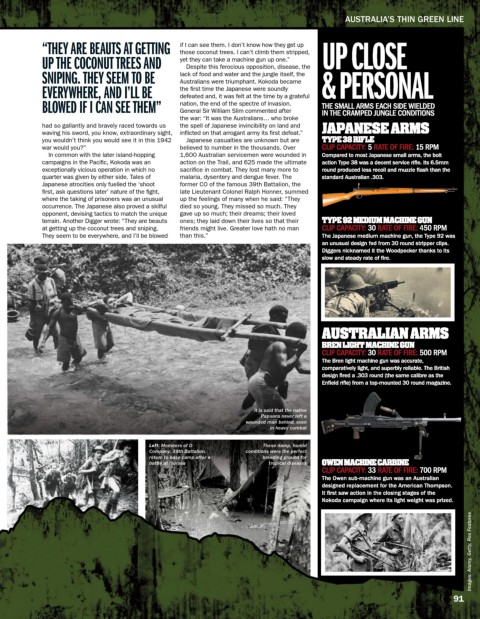
It is said that the native
Papuans never left a
wounded man behind, even
in heavy combat
Left: Members of D These damp, humid
Company, 39th Battalion, conditions were the perfect
return to base camp after a breeding ground for
OWEN MACHINE CARBINE
battle at Isurava tropical diseases O W E N M A C HIN E C ARB IN E
CLIP CAPACITY: 33 RATE OF FIRE: 700 RPM
CLIP CAPACITY: 33 RATE OF FIRE: 700 RPM
T The Owen sub-machine gun was an Australian
h
a
i
n
l
e O
r
a
m
a
s a
-
u
b
n A
c
e g
u
n w
n
h
a
i
u
e
n s
t
s
w
designed replacement for the American Thompson.
d e s i g ne d r ep l ac em en t f o r t h e A m er i c a n T h o m p s o n .
n
h
s
t
n t
t s
g s
r
e
o
l
e c
f t
s
i
c
s o
i
e
h
I It rst saw action in the closing stages of the
t
a
n i
g
w a
o
a
t
K o k o d a c a m p a i g n w h e r e i t s l i g h t w e i g h t w a s p r i z e d .
Kokoda campaign where its light weight was prized.
Images: Alamy, Getty, Rex Features
91
084-091_HOW029_Kokoda_Trail.indd 91 04/05/2016 18:48

