


Page 217 - (DK Eyewitness) Travel Guide - Austria
P. 217
A USTRIA REGION B Y REGION 215
SALZBURGER LAND
The province of Salzburg, a region of high mountains, covers an
area of 7,154 sq km (2,762 sq miles) and has 450,000 inhabitants.
Its neighbours are Germany and the Austrian provinces
of Tyrol, Upper Austria, Styria and Carinthia. A narrow
wedge of land along the peaks of the Hohe Tauern
mountains reaches as far as the Italian border in the south.
Salzburger Land is divided into five regions: the great Migration of Nations in
Flachgau, Tennengebirge, Pongau, Pinzgau 5th-century Europe. It was not until
and Lungau. History has made them the 7th century that monks settled in
different in character and traditions; all Mönchsburg, the future Salzburg, which
are great for sports. became first a bishopric and then an
Colonization of the Salzach valley goes archbishopric. The entire province was
back to prehistoric times. The mineral an independent principality for many
deposits – copper, precious metals and, centuries, governed by an ecclesiastical
above all, salt (Salz in German) from which ruler acting as sovereign prince and,
both the town and province take their depending on political circumstance
names – were being exploited as early and personal preference, associating
as 1000 BC. It was salt which created the himself with the Holy Roman Empire,
basis for the development of the so-called the Austrian Habsburgs or Rome.
Hallstatt civilization that spread from here. Following the Congress of Vienna
The Celtic town of Noricum established in 1815, Salzburg became part of
in the Alpine region ultimately became Austria. Today, the beauty of Salzburg,
a Roman province of the same name. inextricably linked with Mozart, makes
Christianity arrived here early, and its this province a visitor magnet second
turbulent progress was halted only by only to Vienna.
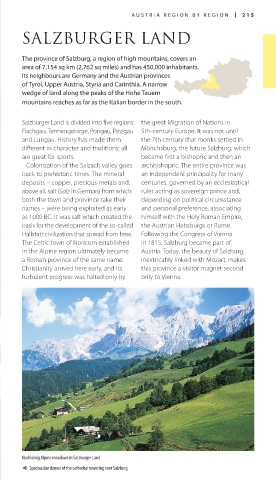
Hochkönig Alpine meadows in Salzburger Land
Spectacular domes of the cathedral towering over Salzburg
214-215_EW_Austria.indd 215 12/09/17 3:04 pm

