


Page 215 - (DK Eyewitness) Travel Guide - Austria
P. 215
UPPER A USTRIA 213
The Salzkammergut
For centuries, the name Salzkammergut applied only to the area
around the Hallstätter See and Traunsee lakes, and to the towns of
Bad Ischl, Hallstatt and Gmunden. Salt has been excavated here since
prehistoric times, ensuring the long-term wealth and development
of the entire region. Salt mines exist in the area to this day. In the
second half of the 19th century the area became famous for its
therapeutic springs, and with time the term Salzkammergut came to
refer to the entire land of lakes and mountains that is now Austria’s
most popular tourist destination. It includes the eastern part of the
Salzburg Alps, with the picturesque mountain ranges of Dachstein
(eastern part), Totes Gebirge (Dead Mountains) and Höllengebirge
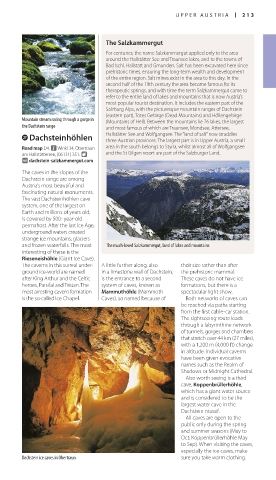
Mountain stream racing through a gorge in (Mountains of Hell). Between the mountains lie 76 lakes, the largest
the Dachstein range and most famous of which are Traunsee, Mondsee, Attersee,
j Dachsteinhöhlen Hallstätter See and Wolfgangsee. The “land of salt” now straddles
three Austrian provinces. The largest part is in Upper Austria, a small
Road map D4. n Winkl 34, Obertraun area in the south belongs to Styria, whilst almost all of Wolfgangsee
am Hallstättersee, (06131) 351. 8 and the St Gilgen resort are part of the Salzburger Land.
∑ dachstein-salzkammergut.com
The caves in the slopes of the
Dachstein range are among
Austria’s most beautiful and
fascinating natural monuments.
The vast Dachsteinhöhlen cave
system, one of the largest on
Earth and millions of years old,
is covered by 500- year-old
permafrost. After the last Ice Age,
under ground waters created
strange ice mountains, glaciers
and frozen waterfalls. The most The much-loved Salzkammergut, land of lakes and mountains
interesting of these is the
Rieseneishöhle (Giant Ice Cave).
The caverns in this surreal under- A little further along, also their size rather than after
ground ice-world are named in a limestone wall of Dachstein, the prehistoric mammal.
after King Arthur and the Celtic is the entrance to a second These caves do not have ice
heroes, Parsifal and Tristan. The system of caves, known as formations, but there is a
most arresting cavern formation Mammuthöhle (Mammoth spectacular light show.
is the so-called Ice Chapel. Caves), so named because of Both networks of caves can
be reached via paths starting
from the first cable-car station.
The sightseeing route leads
through a labyrinthine network
of tunnels, gorges and chambers
that stretch over 44 km (27 miles),
with a 1,200 m (4,000 ft) change
in altitude. Individual caverns
have been given evocative
names such as the Realm of
Shadows or Midnight Cathedral.
Also worth seeing is a third
cave, Koppenbrüller höhle,
which has a giant water source
and is considered to be the
largest water cave in the
Dachstein massif.
All caves are open to the
public only during the spring
and summer seasons (May to
Oct; Koppenbrüllerhöhle May
to Sep). When visiting the caves,
especially the ice caves, make
Dachstein ice caves in Obertraun sure you take warm clothing.
212-213_EW_Austria.indd 213 12/09/17 3:04 pm

