


Page 220 - (DK Eyewitness) Travel Guide - Austria
P. 220
218 A USTRIA REGION B Y REGION
1 Salzburg
Steeped in legend and unrivalled for its Baroque architecture,
Salzburg is most famous as the home of Mozart, who was
born here in 1756. Founded by Benedictine monks, Salzburg
has one of the most evocative old town centres in Europe, as
well as one of the most impressive fortresses, Hohensalzburg.
Music remains, however, the city’s main attraction. The
annual Salzburg Festival is the largest of its kind in Europe,
while some 300,000 visitors a year enjoy tours of the original
locations used in the 1965 film The Sound of Music, including
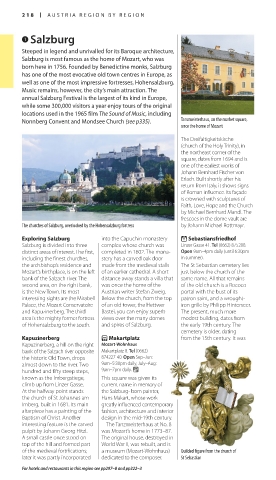
Nonnberg Convent and Mondsee Church (see p335). Tanzmeisterhaus, on the market square,
once the home of Mozart
The Dreifaltigkeitskirche
(church of the Holy Trinity), in
the northeast corner of the
square, dates from 1694 and is
one of the earliest works of
Johann Bernhard Fischer von
Erlach. Built shortly after his
return from Italy, it shows signs
of Roman influence. Its façade
is crowned with sculptures of
Faith, Love, Hope and the Church
by Michael Bernhard Mandl. The
frescoes in the dome vault are
The churches of Salzburg, overlooked by the Hohensalzburg fortress by Johann Michael Rottmayr.
Exploring Salzburg into the Capuchin monastery R Sebastiansfriedhof
Salzburg is divided into three complex whose church was Linzer Gasse 41. Tel (0662) 875208.
distinct areas of interest. The first, completed in 1602. The mona Open 9am–4pm daily (until 6:30pm
including the finest churches, stery has a carved oak door in summer).
the archbishop’s residence and made from the medieval stalls The St Sebastian cemetery lies
Mozart’s birthplace, is on the left of an earlier cathedral. A short just below the church of the
bank of the Salzach river. The distance away stands a villa that same name. All that remains
second area, on the right bank, was once the home of the of the old church is a Rococo
is the New Town. Its most Austrian writer Stefan Zweig. portal with the bust of its
interesting sights are the Mirabell Below the church, from the top patron saint, and a wrought
Palace, the Mozart Conservatoire of an old tower, the Hettwer iron grille by Philipp Hinterseer.
and Kapuzinerberg. The third Bastei, you can enjoy superb The present, much more
area is the mighty former fortress views over the many domes modest building, dates from
of Hohensalzburg to the south. and spires of Salzburg. the early 19th century. The
cemetery is older, dating
Kapuzinerberg P Makartplatz from the 15th century. It was
Kapuzinerberg, a hill on the right Mozart-Wohnhaus
bank of the Salzach river opposite Makartplatz 8. Tel (0662)
the historic Old Town, drops 87422740. Open Sep–Jun:
almost down to the river. Two 9am–5:30pm daily, July–Aug:
hundred and fifty steep steps, 9am–7pm daily. &
known as the Imbergstiege, This square was given its
climb up from Linzer Gasse. current name in memory of
At the halfway point stands the Salzburg born painter,
the church of St Johannes am Hans Makart, whose work
Imberg, built in 1681. Its main greatly influenced contem porary
altarpiece has a painting of the fashion, architecture and interior
Baptism of Christ. Another design in the mid19th century.
interesting feature is the carved The Tanzmeisterhaus at No. 8
pulpit by Johann Georg Hitzl. was Mozart’s home in 1773–87.
A small castle once stood on The original house, destroyed in
top of the hill and formed part World War II, was rebuilt, and is
of the medieval fortifications; a museum (MozartWohnhaus) Guilded figure from the church of
later it was partly incorporated dedicated to the composer. St Sebastian
For hotels and restaurants in this region see pp297–8 and pp322–3
218-219_EW_Austria.indd 218 12/09/17 2:46 pm
Eyewitness Travel LAYERS PRINTED:
Catalogue template “UK” LAYER
(Source v2.1)
Date 5th December 2012
Size 125mm x 217mm

