


Page 10 - Mammal (DK Eyewitness)
P. 10
Making sense of


                                             mammals


                                            We can appreciate the beauty and wonder of
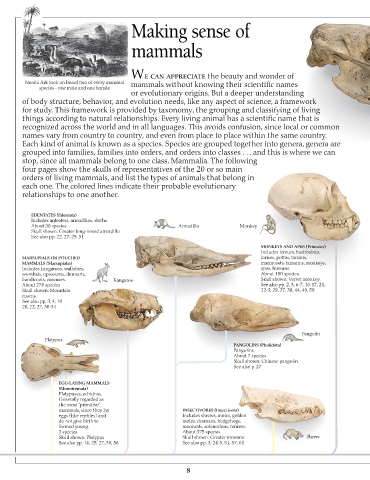
         Noah’s Ark took on board two of every mammal   mammals without knowing their scientific names
              species - one male and one female
                                            or evolutionary origins. But a deeper understanding
        of body structure, behavior, and evolution needs, like any aspect of science, a framework
        for study. This framework is provided by taxonomy, the grouping and classifying of living
        things according to natural relationships. Every living animal has a scientific name that is
        recognized across the world and in all languages. This avoids confusion, since local or common
        names vary from country to country, and even from place to place within the same country.
        Each kind of animal is known as a species. Species are grouped together into genera, genera are
        grouped into families, families into orders, and orders into classes . . . and this is where we can
        stop, since all mammals belong to one class, Mammalia. The following
        four pages show the skulls of representatives of the 20 or so main
        orders of living mammals, and list the types of animals that belong in
        each one. The colored lines indicate their probable evolutionary
        relationships to one another.


           EDENTATES (Edentata)
           Includes anteaters, armadillos, sloths.
           About 30 species                                 Armadillo           Monkey
           Skull shown: Greater long-nosed armadillo
           See also pp. 22, 27, 29, 51
                                                                                       MONKEYS AND APES (Primates)
                                                                                       Includes lemurs, bushbabies,
        MARSUPIALS OR POUCHED                                                          lorises, pottos, tarsiers,
        MAMMALS (Marsupialia)                                                          marmosets, tamarins, monkeys,
        Includes kangaroos, wallabies,                                                 apes, humans.
        wombats, opossums, dunnarts,                                                   About 180 species
        bandicoots, cuscuses.          Kangaroo                                        Skull shown: Vervet monkey
        About 270 species                                                              See also pp. 2, 3, 6-7, 16-17, 21,
        Skull shown: Mountain                                                          22-3, 29, 37, 38, 44, 49, 58
        cuscus
        See also pp, 3, 4, 10
        20, 22, 27, 30-31


                                                                                                     Pangolin
                Platypus
                                                                              PANGOLINS (Pholidota)
                                                                              Pangolins
                                                                              About 7 species
                                                                              Skull shown: Chinese pangolin
                                                                              See also p. 27


                    EGG-LAYING MAMMALS
                    (Monotremata)
                    Platypuses, echidnas.
                    Generally regarded as
                    the most “primitive”
                    mammals, since they lay                  INSECTIVORES (Insectivora)
                    eggs (like reptiles) and                 Includes shrews, moles, golden
                    do not give birth to                     moles, desmans, hedgehogs,
                    formed young.                            moonrats, solenodons, tenrecs.
                    3 species                                About 375 species
                    Skull shown: Platypus                    Skull shown: Greater moonrat             Shrew
                    See also pp. 16, 25, 27, 30, 56          See also pp. 3, 24-5, 51, 57, 61


 (c) 2011 Dorling Kindersley. All Rights Reserved.

