Page 14 - Mammal (DK Eyewitness)
P. 14

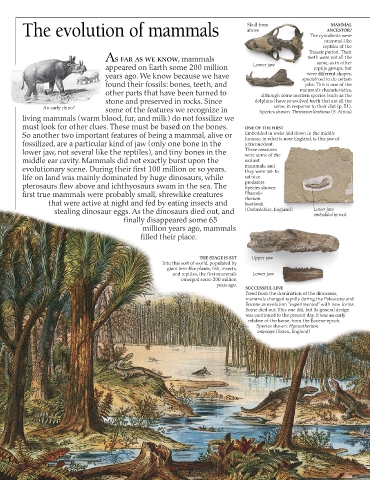
The evolution of mammals                                                   Skull from                ANCESTOR?
                                                                                                               MAMMAL
                                                                                   above
                                                                                                        The cynodonts were
                                                                                                            mammal-like
                                                                                                            reptiles of the
                                                                                                       Triassic period. Their
                                    As far as we know, mammals                                         teeth were not all the
                                                                                                          same, as in other
                                    appeared on Earth some 200 million               Lower jaw           reptile groups, but
                                                                                                       were different shapes,
                                    years ago. We know because we have                               specialized to do certain
                                    found their fossils: bones, teeth, and                            jobs. This is one of the
                                                                                                    mammal’s characteristics,
                                    other parts that have been turned to               although some modern species (such as the
                                    stone and preserved in rocks. Since              dolphins) have re-evolved teeth that are all the
                                                                                            same, in response to their diet (p. 51).
               An early rhino?      some of the features we recognize in               Species shown: Thrinaxon liorhinus (S. Africa)
        living mammals (warm blood, fur, and milk) do not fossilize we
        must look for other clues. These must be based on the bones.              ONE OF THE FIRST
        So another two important features of being a mammal, alive or             Embedded in rocks laid down in the middle
                                                                                  Jurassic, in what is now England, is this jaw of
        fossilized, are a particular kind of jaw (only one bone in the            a triconodont.
        lower jaw, not several like the reptiles), and tiny bones in the          These creatures
                                                                                  were some of the
        middle ear cavity. Mammals did not exactly burst upon the                 earliest
        evolutionary scene. During their first 100 million or so years,           mammals, and
                                                                                  they were rat- to
        life on land was mainly dominated by huge dinosaurs, while                cat-size
        pterosaurs flew above and ichthyosaurs swam in the sea. The               predators.
                                                                                  Species shown:
        first true mammals were probably small, shrewlike creatures               Phascolo­
                                                                                  therium
                 that were active at night and fed by eating insects and          bucklandi
                   stealing dinosaur eggs. As the dinosaurs died out, and         (Oxfordshire, England)  Lower jaw
                                                                                                         embedded in rock
                                          finally disappeared some 65
                                                million years ago, mammals
                                                filled their place.


                                                                   THE STAGE IS SET  Upper jaw
                                                       Into this sort of world, populated by
                                                        giant fern-like plants, fish, insects,
                                                          and reptiles, the first mammals   Lower jaw
                                                             emerged some 200 million
                                                                         years ago.
                                                                                  SUCCESSFUL LINE
                                                                                  Freed from the domination of the dinosaurs,
                                                                                  mammals changed rapidly during the Paleocene and
                                                                                  Eocene as evolution “experimented” with new forms.
                                                                                  Some died out. This one did, but its general design
                                                                                  was continued to the present day. It was an early
                                                                                   relative of the horse, from the Eocene epoch.
                                                                                      Species shown: Hyracotherium
                                                                                      vulpiceps (Essex, England)
   9   10   11   12   13   14   15   16   17   18   19