


Page 44 - Mammal (DK Eyewitness)
P. 44
...continues


                                        Plant-eating mammals may have to travel and search to locate
                                        food, but once found, the plant is relatively easy to “catch.” For the
                                        hunting carnivore (meat eater), finding food is more risky. It
             Playful dolphins: these very   involves much effort, stalking, or tracking prey. When it comes to
            social marine mammals seem to
                follow ships for fun.   the kill, there is a risk of injury from the victim’s defenses (p. 26).
                                        If the prey escapes, time and energy has been wasted. So it is not
        surprising that the play of young carnivores, such as cats and dogs, appears to mirror so many
        features of adult hunting life. To prevent misunderstanding and accidental injury, it is important
        that the animal wishing to play conveys this fact to its fellows; otherwise they might take its
        actions seriously. A puppy will make a “play bow,” crouching down on its chest, rump and back
        legs up, tail wagging and ears pricked forward, in a posture that says: "Let's play!" Human
        children have their equivalent - a giggle that takes them into the world of make- believe.


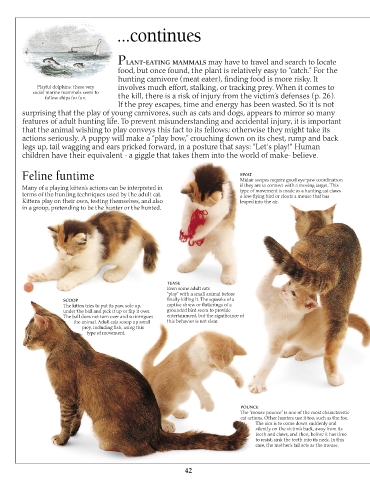
        Feline funtime                                                          SWAT
                                                                                Midair swipes require good eye-paw coordination
        Many of a playing kitten’s actions can be interpreted in                if they are to connect with a moving target. This
                                                                                type of movement is made as a hunting cat claws
        terms of the hunting techniques used by the adult cat.                  a low-flying bird or clouts a mouse that has
        Kittens play on their own, testing themselves, and also                 leaped into the air.
        in a group, pretending to be the hunter or the hunted.


                                                        TEASE
                                                        Even some adult cats
                                                        “play” with a small animal before
                      SCOOP                             finally killing it. The squeaks of a
                      The kitten tries to put its paw, sole up,   captive shrew or flutterings of a
                      under the ball and pick it up or flip it over.   grounded bird seem to provide
                      The ball does not turn over and so intrigues   entertainment, but the significance of
                         the animal. Adult cats scoop up small   this behavior is not clear.
                            prey, including fish, using this
                              type of movement.


                                                                                 POUNCE
                                                                                 The “mouse pounce” is one of the most characteristic
                                                                                 cat actions. Other hunters use it too, such as the fox.
                                                                                      The aim is to come down suddenly and
                                                                                      silently on the victim’s back, away from its
                                                                                      teeth and claws, and then, before it has time
                                                                                      to resist, sink the teeth into its neck. In this
                                                                                      case, the mother’s tail acts as the mouse.


                                                              42


 (c) 2011 Dorling Kindersley. All Rights Reserved.

