


Page 40 - Mammal (DK Eyewitness)
P. 40
Growing up


        Compared to other animals, mammal parents invest a
        lot of time and energy in their young. An insect may lay
        hundreds of eggs and leave them to their own devices. A sea
        urchin casts thousands of eggs into the water and has
        nothing more to do with them. Mammals adopt a different
        strategy. In general, they have only a few offspring, but they
        look after them well. The young are cleaned, fed, kept warm,
        protected, taught, and generally cared for until they are self-
        sufficient. The degree of parental care varies, however, within
        the mammal group. We are at one end of the spectrum:
        human parents spend many years raising their children. The
        mother tree shrew is at the other end - she leaves the young
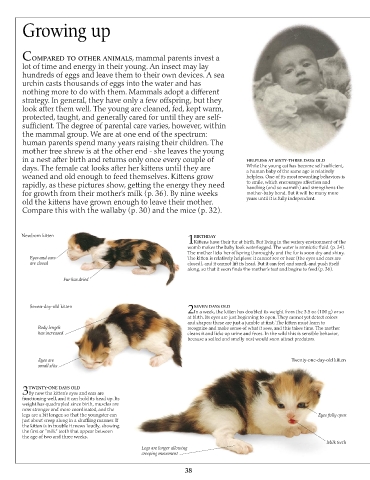
        in a nest after birth and returns only once every couple of                HELPLESS AT SIXTY-THREE DAYS OLD
        days. The female cat looks after her kittens until they are                While the young cat has become self-sufficient,
                                                                                   a human baby of the same age is relatively
        weaned and old enough to feed themselves. Kittens grow                     helpless. One of its most rewarding behaviors is
        rapidly, as these pictures show, getting the energy they need              to smile, which encourages affection and
                                                                                   handling (and so warmth) and strengthens the
        for growth from their mother’s milk (p. 36). By nine weeks                 mother-baby bond. But it will be many more
        old the kittens have grown enough to leave their mother.                   years until it is fully independent.
        Compare this with the wallaby (p. 30) and the mice (p. 32).


        Newborn kitten                                           BIRTHDAY
                                                               1Kittens have their fur at birth. But living in the watery environment of the
                                                               womb makes the baby look waterlogged. The water is amniotic fluid. (p. 34).
                                                               The mother licks her offspring thoroughly and the fur is soon dry and shiny.
           Eyes and ears                                       The kitten is relatively helpless: it cannot see or hear (the eyes and ears are
           are closed                                          closed), and it cannot lift its head. But it can feel and smell, and push itself
                                                               along, so that it soon finds the mother’s teat and begins to feed (p. 36).
                      Fur has dried


           Seven-day-old kitten                                  SEVEN DAYS OLD
                                                               2In a week, the kitten has doubled its weight from the 3.5 oz (100 g) or so
                                                               at birth. Its eyes are just beginning to open. They cannot yet detect colors
                                                               and shapes; these are just a jumble at first. The kitten must learn to
              Body length                                      recognize and make sense of what it sees, and this takes time. The mother
              has increased                                    cleans it and licks up urine and feces. In the wild this is sensible behavior,
                                                               because a soiled and smelly nest would soon attract predators.


              Eyes are                                                                            Twenty-one-day-old kitten
              small slits


           TWENTY-ONE DAYS OLD
        3By now the kitten’s eyes and ears are
        functioning well, and it can hold its head up. Its
        weight has quadrupled since birth, muscles are
        now stronger and more coordinated, and the
        legs are a bit longer, so that the youngster can                                                  Eyes fully open
        just about creep along in a shuffling manner. If
        the kitten is in trouble it mews loudly, showing
        the first or “milk” teeth that appear between
        the age of two and three weeks.
                                                                                                             Milk teeth
                                                Legs are longer allowing
                                                creeping movement

                                                              3


 (c) 2011 Dorling Kindersley. All Rights Reserved.

