


Page 42 - Mammal (DK Eyewitness)
P. 42
The game of life


                             It is difficult to imagine an ant or a leech playing. What we humans call
                             play seems fairly restricted to mammals, with their well-developed senses and
                             ability to learn and to be intelligent. Play occurs chiefly in young mammals. It
                             is generally an unserious business, seemingly carried out for its own sake,
                             with none of the purpose found in adult behavior patterns such as feeding or
        Not a natural object, but   establishing a territory. Young chimps chase in a rough-and-tumble, badger
        the baby orang could be
        learning to manipulate   cubs roll and frolic on the forest floor, and even baby platypuses waddle
        a ripe fruit         around, squealing and yelping like puppies. Theories about why young
                             mammals play are not in short supply. For the individual, it helps to develop
                             strong muscles and good coordination. For survival, it trains a carnivore in
                             hunting techniques or a herbivore in detection of and flight from threat. For
                             social mammals it provides a basis in communication, in the use of sounds
                                 and body posture to send messages of dominance and submission that
                                       coordinate the group. Do adult humans play? Probably, but we use
                                        different words. Sports, hobbies, and pastimes are sometimes
                                          called “play.”


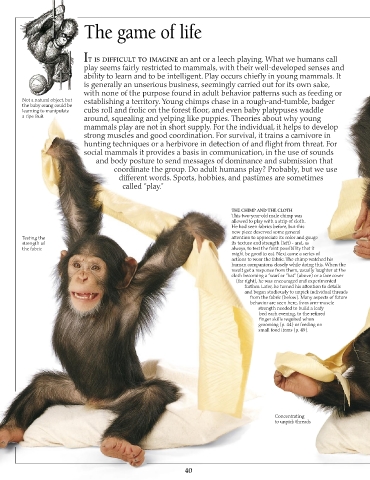
                                                                              THE CHIMP AND THE CLOTH
                                                                              This two-year-old male chimp was
                                                                              allowed to play with a strip of cloth.
                                                                              He had seen fabrics before, but this
                                                                              new piece deserved some general
        Testing the                                                           attention to appreciate its color and gauge
        strength of                                                           its texture and strength (left) - and, as
        the fabric                                                            always, to test the faint possibility that it
                                                                              might be good to eat. Next came a series of
                                                                              actions to wear the fabric. The chimp watched his
                                                                              human companions closely while doing this. When the
                                                                              result got a response from them, usually laughter at the
                                                                              cloth becoming a “scarf or “hat” (above) or a face cover
                                                                               (far right), he was encouraged and experimented
                                                                                  further. Later, he turned his attention to details
                                                                                  and began studiously to unpick individual threads
                                                                                    from the fabric (below). Many aspects of future
                                                                                    behavior are seen here, from arm-muscle
                                                                                       strength needed to build a leafy
                                                                                       bed each evening, to the refined
                                                                                       finger skills required when
                                                                                       grooming (p. 44) or feeding on
                                                                                       small food items (p. 49).


                                                                                            Concentrating
                                                                                            to unpick threads


                                                              40


 (c) 2011 Dorling Kindersley. All Rights Reserved.

