


Page 72 - Mammal (DK Eyewitness)
P. 72
Glossary


           AMNIOTIC MEMBRANE  A thin membrane                                       FETUS  An unborn mammal in the later
           that surrounds a developing embryo inside its                            stages of development
           mother’s uterus, or womb
                                                                                    FOOD CHAIN  A food pathway that links
           ARTIODACTYL  A hoofed mammal that has                                    different species in a community, passing
           an even number of toes on each foot, usually                             down energy and nutrients from one
           two, but sometimes four. Deer, camels, and                               organism to another. Each species is usually
           sheep all fall into this group.                                          involved in several different food chains. The
                                                                                    amount of energy passed on decreases at
           BALEEN PLATES  The fringed plates that                                   each stage.
           hang from the roof of the mouth of the largest
           types of whale. Baleen plates filter small                               FOSSIL  The remains or traces of a living
           animals from sea water for food.                                         thing preserved in rock
           CAMOUFLAGE  The means by which an                                        GENE  The basic unit of heredity. Genes are
           animal escapes the notice of predators, usually                          passed from parents to offspring and
           because it blends in with its surroundings                               determine each living thing’s characteristics.
                                                                                    Most genes are made of DNA.
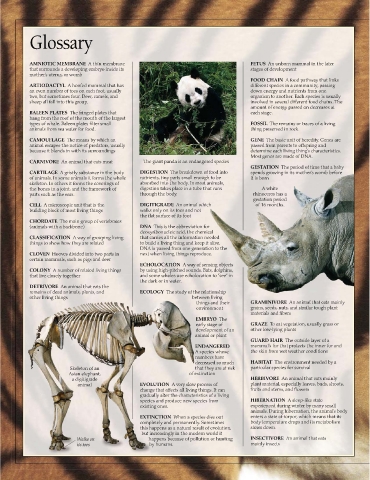
           CARNIVORE  An animal that eats meat  The giant panda is an endangered species
                                                                                    GESTATION  The period of time that a baby
           CARTILAGE  A gristly substance in the body   DIGESTION The breakdown of food into   spends growing in its mother’s womb before
           of animals. In some animals it forms the whole   nutrients, tiny parts small enough to be   it is born
           skeleton. In others it forms the coverings of   absorbed into the body. In most animals,
           the bones in a joint, and the framework of   digestion takes place in a tube that runs   A white
           parts such as the ears.             through the body.                     rhinoceros has a
                                                                                     gestation period
           CELL A microscopic unit that is the   DIGITIGRADE  An animal which         of 16 months.
           building block of most living things  walks only on its toes and not
                                               the flat surface of its foot
           CHORDATE  The main group of vertebrates
           (animals with a backbone)           DNA  This is the abbreviation for
                                               deoxyribonucleic acid, the chemical
           CLASSIFICATION  A way of grouping living   that carries all the information needed
           things to show how they are related  to build a living thing and keep it alive.
                                               DNA is passed from one generation to the
           CLOVEN  Hooves divided into two parts in   next when living things reproduce.
           certain mammals, such as pigs and deer
                                               ECHOLOCATION  A way of sensing objects
           COLONY  A number of related living things   by using high-pitched sounds. Bats, dolphins,
           that live closely together          and some whales use echolocation to “see” in
                                               the dark or in water.
           DETRIVORE  An animal that eats the
           remains of dead animals, plants, and   ECOLOGY  The study of the relationship
           other living things                                   between living
                                                                  things and their   GRAMINIVORE An animal that eats mainly
                                                                  environment       grains, seeds, nuts, and similar tough plant
                                                                                    materials and fibers
                                                                  EMBRYO The
                                                                  early stage of    GRAZE  To eat vegetation, usually grass or
                                                                  development of an   other low-lying plants
                                                                  animal or plant
                                                                                    GUARD HAIR  The outside layer of a
                                                                  ENDANGERED        mammal’s fur that protects the inner fur and
                                                                  A species whose   the skin from wet weather conditions
                                                                  numbers have
                                                                  decreased so much   HABITAT  The environment needed by a
                        Skeleton of an                            that they are at risk   particular species for survival
                        Asian elephant,                         of extinction
                         a digitigrade                                              HERBIVORE  An animal that eats mainly
                           animal              EVOLUTION  A very slow process of    plant material, especially leaves, buds, shoots,
                                               change that affects all living things. It can   fruits and stems, and flowers
                                               gradually alter the characteristics of a living
                                               species and produce new species from   HIBERNATION  A sleep-like state
                                               existing ones.                       experienced during winter by many small
                                                                                    animals. During hibernation, the animal’s body
                                               EXTINCTION  When a species dies out   enters a state of torpor, which means that its
                                               completely and permanently. Sometimes   body temperature drops and its metabolism
                                               this happens as a natural result of evolution,   slows down.
                                                but increasingly in the modern world it
                          Walks on                happens because of pollution or hunting   INSECTIVORE  An animal that eats
                          its toes                by humans.                        mainly insects

