


Page 73 - Mammal (DK Eyewitness)
P. 73
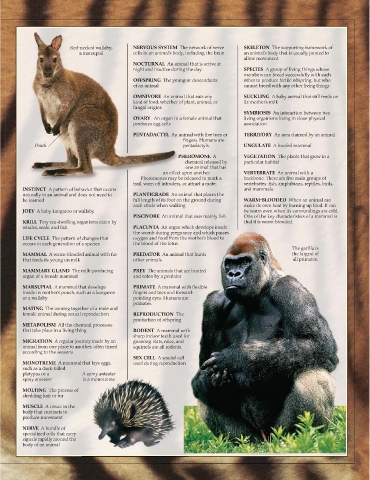
Red-necked wallaby, NERVOUS SYSTEM The network of nerve SKELETON The supporting framework of
a marsupial cells in an animal’s body, including the brain an animal’s body that is usually jointed to
allow movement
NOCTURNAL An animal that is active at
night and inactive during the day SPECIES A group of living things whose
members can breed successfully with each
OFFSPRING The young or descendants other to produce fertile offspring, but who
of an animal cannot breed with any other living things
OMNIVORE An animal that eats any SUCKLING A baby animal that still feeds on
kind of food, whether of plant, animal, or its mother’s milk
fungal origins
SYMBIOSIS An interaction between two
OVARY An organ in a female animal that living organisms living in close physical
produces egg cells association
PENTADACTYL An animal with five toes or TERRITORY An area claimed by an animal
fingers. Humans are
Pouch pentadactyls. UNGULATE A hoofed mammal
PHEROMONE A VEGETATION The plants that grow in a
chemical released by particular habitat
one animal that has
an effect upon another. VERTEBRATE An animal with a
Pheromones may be released to mark a backbone. There are five main groups of
trail, warn off intruders, or attract a mate. vertebrates: fish, amphibians, reptiles, birds,
INSTINCT A pattern of behavior that occurs and mammals.
naturally in an animal and does not need to PLANTIGRADE An animal that places the
be learned full length of its foot on the ground during WARMBLOODED When an animal can
each stride when walking make its own heat by burning up food. It can
JOEY A baby kangaroo or wallaby be warm even when its surroundings are cold.
PISCIVORE An animal that eats mainly fish One of the key characteristics of a mammal is
KRILL Tiny sea-dwelling organisms eaten by that it is warm-blooded.
whales, seals, and fish PLACENTA An organ which develops inside
the womb during pregnancy and which passes
LIFE CYCLE The pattern of changes that oxygen and food from the mother’s blood to
occurs in each generation of a species the blood of the fetus
The gorilla is
MAMMAL A warm-blooded animal with fur PREDATOR An animal that hunts the largest of
that feeds its young on milk other animals all primates.
MAMMARY GLAND The milk-producing PREY The animals that are hunted
organ of a female mammal and eaten by a predator
MARSUPIAL A mammal that develops PRIMATE A mammal with flexible
inside its mother’s pouch, such as a kangaroo fingers and toes and forward-
or a wallaby pointing eyes. Humans are
primates.
MATING The coming together of a male and
female animal during sexual reproduction REPRODUCTION The
production of offspring
METABOLISM All the chemical processes
that take place in a living thing RODENT A mammal with
sharp incisor teeth used for
MIGRATION A regular journey made by an gnawing. Rats, mice, and
animal from one place to another, often timed squirrels are all rodents.
according to the seasons
SEX CELL A special cell
MONOTREME A mammal that lays eggs, used during reproduction
such as a duck-billed
platypus or a A spiny anteater
spiny anteater is a monotreme
MOLTING The process of
shedding hair or fur
MUSCLE A tissue in the
body that contracts to
produce movement
NERVE A bundle of
specialized cells that carry
signals rapidly around the
body of an animal

