


Page 68 - Mammal (DK Eyewitness)
P. 68
Mammal                 classification


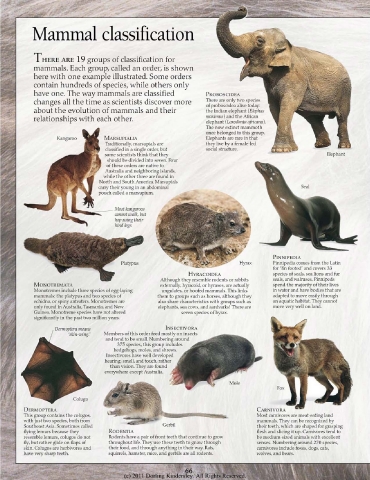
            THERE    ARE 19 groups    of classification  for
            mammals. Each group, called an order, is shown
            here with   one example illustrated. Some orders
            contain hundreds    of species, while others   only
            have one. The way mammals are        classified          PROBOSCIDEA
            changes   all the time  as scientists  discover more     There are only two  species
                                                                               alive today:
                                                                     of proboscidea
            about the evolution    of mammals and their              the Indian elephant (Elephas
            relationships with   each  other.                        maximus)  and the  African
                                                                     elephant (Loxodonta africana).
                                                                     The now extinct mammoth
                                                                     once belonged to this group.
                                    MARSUPIALIA                      Elephants  are rare in that
                                    Traditionally, marsupials are    they live by a female-led
                                    classified in a single order, but   social structure.
                                    some scientists think that they                                          Elephant
                                    should be divided into seven. Four
                                    of these orders are native to
                                    Australia and neighboring islands,
                                   while the other three are found  in
                                  North and South America. Marsupials
                                  carry their young in an  abdominal
                                  pouch called a marsupium.

                                       Most kangaroos
                                       cannot walk, but
                                       hop using their
                                       hind legs.


                                                                                           PlNNIPEDIA
                                                                                           Pinnipedia comes from the  Latin
                                                                                           for  “fin footed”  and covers 33
                                                               HYRACOIDEA                  species of seals, sea lions and  fur
                                                      Although they resemble rodents  or rabbits   seals, and walruses. Pinnipeds
            MONOTREMATA                               externally, hyracoid, or hyraxes, are actually   spend the majority  of their lives
            Monotremes include three species  of egg-laying   ungulates, or hoofed mammals. This links   in water and have bodies that  are
            mammals: the platypus and two species of   them to groups such as horses, although they   adapted to move easily through
            echidna, or spiny anteaters. Monotremes  are  also share characteristics with groups such as   an aquatic habitat. They cannot
            only found  in Australia, Tasmania, and New   elephants, sea cows, and aardvarks! There are   move very well on land.
            Guinea. Monotreme species have not  altered      seven species of hyrax.
            significantly in the past two million years.
                   Dermoptera means                     INSECTIVORA
                        “skin-wing.”   Members  of this order feed mostly on insects
                                    and tend to be small. Numbering around
                                        375 species, this group  includes
                                       hedgehogs, moles, and shrews.
                                    Insectivores have well developed
                                    hearing, smell, and touch, rather
                                     than vision. They are found
                                    everywhere except Australia.


         DERMOPTERA                                                                   CARNIVORA
         This group contains the colugos,                                             Most carnivores are meat-eating land
         with just two species, both  from                                            mammals. They can be recognized by
         Southeast Asia. Sometimes  called             Gerbil                         their teeth, which are shaped  for grasping
         flying lemurs because they   RODENTIA                                        flesh and slicing it up. Carnivores tend to
         resemble lemurs, colugos do not   Rodents have a pair  of front teeth that continue to grow   be medium-sized animals with  excellent
         fly, but rather glide on flaps  of  throughout life. They use these teeth to gnaw through   senses. Numbering around 270 species,
         skin. Colugos are herbivores  and  their food, and through anything in their way. Rats,   carnivores include foxes, dogs, cats,
         have very sharp teeth.      squirrels, hamster, mice, and gerbils are all rodents.   wolves, and bears.

                                                              66

