


Page 201 - (DK Eyewitness) Travel Guide - Argentina
P. 201
C ÓRDOBA AND THE ANDEAN NOR THWEST 199
for a building that was
completed piecemeal
over several centuries,
the overall effect is a
pleas ing one of har mony
and balance, of Latino
exuberance tempered
by Latinist rigor.
R Iglesia y Convento
San Bernardo
Calle Caseros 73. Tel (0387)
431-0092. Open 9am–noon,
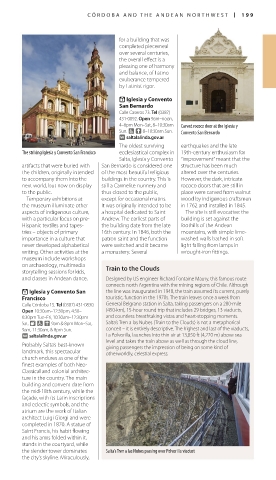
4–6pm Mon–Sat, 8–10:30am Carved rococo door at the Iglesia y
Sun. 7 5 8–10:30am Sun. Convento San Bernardo
∑ saltalalinda.gov.ar
The oldest surviving earthquakes and the late
The striking Iglesia y Convento San Francisco ecclesiastical complex in 19th-century enthusiasm for
Salta, Iglesia y Convento “improvement” meant that the
artifacts that were buried with San Bernardo is considered one structure has been much
the children, originally intended of the most beautiful religious altered over the centuries.
to accompany them into the buildings in the country. This is However, the dark, intricate
next world, but now on display still a Carmelite nunnery and rococo doors that are still in
to the public. thus closed to the public, place were carved from walnut
Temporary exhibitions at except for occa sional matins. wood by indigenous crafts men
the museum illuminate other It was originally intended to be in 1762 and installed in 1845.
aspects of indigenous culture, a hospital dedicated to Saint The site is still evocative: the
with a particular focus on pre- Andrew. The earliest parts of building is set against the
Hispanic textiles and tapes- the building date from the late foothills of the Andean
tries – objects of primary 16th century. In 1846, both the mountains, with simple lime-
importance in a culture that patron saint and the function washed walls bathed in soft
never developed alphabetical were switched and it became light falling from lamps in
writing. Other activities at the a monastery. Several wrought-iron fittings.
museum include workshops
on archaeology, multimedia Train to the Clouds
storytelling sessions for kids,
and classes in Andean dance. Designed by US engineer Richard Fontaine Maury, this famous route
connects north Argentina with the mining regions of Chile. Although
R Iglesia y Convento San the line was inaugurated in 1948, the train assumed its current, purely
Francisco touristic, function in the 1970s. The train leaves once a week from
Calle Córdoba 15. Tel (0387) 431-0830. General Belgrano station in Salta, taking passengers on a 280-mile
Open 10:30am–12:30pm, 4:30– (450-km), 15-hour round trip that includes 29 bridges, 13 viaducts,
6:30pm Tue–Fri, 10:30am–12:30pm and countless breathtaking vistas and heart-stopping moments.
Sat. 8 7 5 9am & 8pm Mon–Sat, Salta’s Tren a las Nubes (Train to the Clouds) is not a metaphorical
9am, 11:30am, & 8pm Sun. conceit – it is entirely descriptive. The highest and last of the viaducts,
∑ saltalalinda.gov.ar La Polvorilla, launches into thin air at 13,850 ft (4,220 m) above sea
level and takes the train above as well as through the cloud line,
Probably Salta’s best-known giving passengers the impression of being on some kind of
landmark, this spectacular otherworldly, celestial express.
church endures as one of the
finest examples of both Neo-
Classical and colonial architec-
ture in the country. The main
building and con vent date from
the mid-18th century, while the
façade, with its Latin inscrip tions
and eclectic symbols, and the
atrium are the work of Italian
architect Luigi Giorgi and were
com pleted in 1870. A statue of
Saint Francis, his habit flowing
and his arms folded within it,
stands in the court yard, while
the slender tower dominates Salta’s Tren a las Nubes passing over Polvorilla viaduct
the city’s sky line. Miraculously,
198-199_EW_Argentina.indd 199 05/08/16 10:41 am

