


Page 196 - (DK Eyewitness) Travel Guide - Argentina
P. 196
PB ARGENTINA REGION B Y REGION
194 ARGENTINA REGION B Y REGION
u Cafayate
Road map B1. 140 miles (225 km) NW
of Tucumán. * 12,000. @ n San
Martín 26, (03868) 422-442/422-223.
_ Folk Festival (Mar).
∑ turismosalta.gov.ar
Considered one of the prettiest
towns in Argentina, Cafayate is
a natural stopover for anyone
touring the Valles Calchaquíes
or traveling between Quilmes,
Tucumán, and Salta. Cafayate
was settled at the beginning of
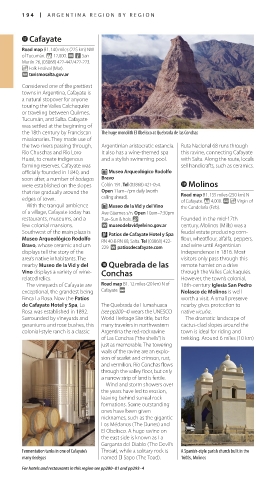
the 18th century by Franciscan The huge monolith El Obelisco at Quebrada de las Conchas
missionaries. They made use of
the two rivers passing through, Argentinian aristocratic estancia. Ruta Nacional 68 runs through
Río Chuschas and Río Loro It also has a wine-themed spa this ravine, connecting Cafayate
Huasi, to create indigenous and a sty lish swimming pool. with Salta. Along the route, locals
farming reserves. Cafayate was sell handi crafts, such as ceramics.
offi cially founded in 1840, and E Museo Arqueológico Rodolfo
soon after, a number of bodegas Bravo
were established on the slopes Colón 191. Tel (03868) 421-054. o Molinos
that rise gradually around the Open 11am–7pm daily (worth Road map B1. 155 miles (250 km) N
edges of town. calling ahead). of Cafayate. * 4,000. @ _ Virgin of
With the tranquil ambience E Museo de la Vid y del Vino the Candelaria (Feb).
of a village, Cafayate today has Ave Güemes s/n. Open 10am–7:30pm
restaurants, museums, and a Tue–Sun & hols. & Founded in the mid-17th
few colonial mansions. ∑ museodelavidyelvino.gov.ar century, Molinos (Mills) was a
Southwest of the main plaza is Patios de Cafayate Hotel y Spa feudal estate producing corn-
Museo Arqueológico Rodolfo RN 40 & RN 68, Salta. Tel (03868) 422- flour, wheatflour, alfalfa, peppers,
Bravo, whose ceramic and urn 229. ∑ patiosdecafayate.com and wine until Argentinian
displays tell the story of the Independence in 1816. Most
area’s native inhabi tants. The visitors only pass through this
nearby Museo de la Vid y del i Quebrada de las remote hamlet on a drive
Vino displays a variety of wine- Conchas through the Valles Calchaquiés.
related relics. However, the town’s colo nial,
The vineyards of Cafayate are Road map B1. 12 miles (20 km) N of 18th-century Iglesia San Pedro
exceptional, the grandest being Cafayate. @ Nolasco de Molinos is well
Finca La Rosa. Now the Patios worth a visit. A small preserve
de Cafayate Hotel y Spa, La The Quebrada de Humahuaca nearby gives protec tion to
Rosa was established in 1892. (see pp200–4) wears the UNESCO native vicuña.
Surrounded by vine yards and World Heritage Site title, but for The dramatic landscape of
geraniums and rose bushes, this many travelers in northwestern cactus-clad slopes around the
colonial-style ranch is a classic Argentina the red-rock ravine town is ideal for riding and
of Las Conchas (“the shells”) is trekking. Around 6 miles (10 km)
just as memorable. The tower ing
walls of the ravine are an explo-
sion of scarlet and crimson, rust,
and vermil ion. Río Conchas flows
through the valley floor, but only
a narrow strip of land is fertile.
Wind and storm showers over
the years have led to erosion,
leaving behind sur real rock
formations. Some outstand ing
ones have been given
nicknames, such as the gigan tic
Los Médanos (The Dunes) and
El Obelisco. A huge ravine on
the east side is known as La
Garganta del Diablo (The Devil’s
Fermentation tanks in one of Cafayate’s Throat), while a solitary rock is A Spanish-style parish church built in the
many bodegas named El Sapo (The Toad). 1600s, Molinos
For hotels and restaurants in this region see pp280–81 and pp293–4
194-195_EW_Argentina.indd 194 05/08/16 10:41 am
Eyewitness Travel LAYERS PRINTED:
Catalogue template “UK” LAYER
(Source v2.6)
Date 12th July 2013
Size 125mm x 217mm

