


Page 249 - (DK Eyewitness) Travel Guide - Argentina
P. 249
P A T A GONIA 247
illustrate the link between the
hunters’ earthly world and its
spirit equivalent. Paintings from
7,000 years ago show hun dreds
of heavily pregnant guanacos
standing still. These are thought
to be some kind of painted
prayer, beseeching the return of
the animals during a period of
drought that had seen them
migrate to better pastures.
Stylized forms mark the
cave’s most recent art, dating
from 1,500 to 4,000 years
ago. Biomorphic motifs of
frogs, lizards, hawks, and
pumas, and geometrical
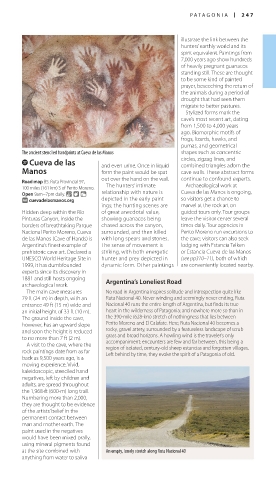
The ancient stenciled handprints at Cueva de las Manos shapes such as concentric
, Cueva de las and even urine. Once in liquid circles, zigzag lines, and
combined triangles adorn the
Manos form the paint would be spat cave walls. These abstract forms
out over the hand on the wall. continue to confound experts.
Road map B5. Ruta Provincial 97,
100 miles (161 km) S of Perito Moreno. The hunters’ intimate Archaeological work at
Open 9am−7pm daily. & 8 = relationship with nature is Cueva de las Manos is ongoing,
∑ cuevadelasmanos.org depicted in the early paint- so visitors get a chance to
ings; the hunting scenes are marvel at the rock art on
Hidden deep within the Río of great anecdotal value, guided tours only. Tour groups
Pinturas Canyon, inside the showing guanacos being leave the visitor center several
borders of breathtaking Parque chased across the canyon, times daily. Tour agencies in
Nacional Perito Moreno, Cueva surrounded, and then killed Perito Moreno run excursions to
de las Manos (Cave of Hands) is with long spears and stones. the cave; visi tors can also seek
Argentina’s finest example of The sense of movement is lodging with Estancia Telken
prehistoric cave art. Declared a striking, with both ener getic or Estancia Cueva de las Manos
UNESCO World Heritage Site in hunter and prey depicted in (see pp310–11), both of which
1999, it has dumb founded dynamic form. Other paintings are conveniently located nearby.
experts since its discovery in
1881 and still hosts ongoing Argentina’s Loneliest Road
archaeo logical work.
The main cave measures No road in Argentina inspires solitude and introspection quite like
79 ft (24 m) in depth, with an Ruta Nacional 40. Never winding and seemingly never ending, Ruta
entrance 49 ft (15 m) wide and Nacional 40 runs the entire length of Argentina, but finds its true
an initial height of 33 ft (10 m). heart in the wilderness of Patagonia; and nowhere more so than in
The ground inside the cave, the 390-mile (628-km) stretch of nothingness that lies between
however, has an upward slope Perito Moreno and El Calafate. Here, Ruta Nacional 40 becomes a
and soon the height is reduced rocky, gravel artery, surrounded by a featureless landscape of scrub
to no more than 7 ft (2 m). grass and broad horizons. A howling wind is the traveler’s only
accompaniment; encounters are few and far between, this being a
A visit to the cave, where the region of isolated, century-old sheep estancias and forgotten villages.
rock paintings date from as far Left behind by time, they evoke the spirit of a Patagonia of old.
back as 9,500 years ago, is a
moving experience. Vivid,
kaleidoscopic, stenciled hand
negatives, left by children and
adults, are spread throughout
the 1,968-ft (600-m) long trail.
Numbering more than 2,000,
they are thought to be evidence
of the artists’ belief in the
permanent contact between
man and mother earth. The
paint used in the negatives
would have been mixed orally,
using mineral pigments found
at the site combined with An empty, lonely stretch along Ruta Nacional 40
anything from water to saliva
246-247_EW_Argentina.indd 247 05/08/16 10:42 am

