


Page 55 - (DK Eyewitness) Travel Guide - Argentina
P. 55
INTRODUCING ARGENTINA 53
THE HISTORY
OF ARGENTINA
A land of Native American civilizations for millennia, Argentina became a
Spanish colonial back water before trans forming itself into one of the world’s
richest coun tries by the late 19th century. A study in paradox, it followed this
by an era of popu list politics, dictator ships, and fluctuating econo mic cycles.
Never losing its vitality, today, while retaining many populist policies and in
the face of a volatile economy, it is nevertheless enjoying a robust recovery.
The vast area now known as Spanish Settlement
Argentina was relatively sparsely Brief explorations into the region
populated until the period of were made in the early 1500s by
European colo ni za tion in the 16th the Spanish and Portuguese, but the
century. The most densely popula ted first serious attempt by Europeans at
areas were the Litoral north east and settling Argentina came in 1536.
Andean Northwest. In the former, the Spanish explorer Pedro de Mendoza
semi-nomadic Guaraní inhabi ted large sailed into the Río de la Plata estuary,
vil lages, ruled over by male chiefs. They founding the settle ment of Nuestra
subsisted mainly on manioc, wild game, Señora Santa María del Buen Aire on
and maize. In the northwest, a number its south western bank. However, under
of distinct sedentary cultures had attack from natives, Mendoza aban doned
evolved, each inter linked by trade. the region in 1537. Further efforts at
Collectively known as the Diaguita, settling the country emerged from the
these peoples were conquered and central Andes. Spanish conquistadors
absorbed by the Inca Empire around moved south from the defeated Inca
1480. Farther south, the Huarpe, who Empire and east from the Chilean frontier,
inhabited the Cuyo region, and the founding settle ments such as Santiago
Mapuche, in northern Patagonia, had del Estero in 1553 and Salta in 1582. By
developed settled communities, the 1600s, these focused on providing
subsisting on hunting, fishing, and the foodstuffs and live stock for the Spanish
growing of crops such as corn and Viceroy in Lima.
quinoa. Other groups were nomadic Meanwhile, forced labor and the
hunter-gatherers, including the introduction of European diseases
Pampa and the Tehuelche, who devastated indigenous populations,
roamed the central plains and which dropped by over 90 percent in
Patagonian steppe respectively. four generations.
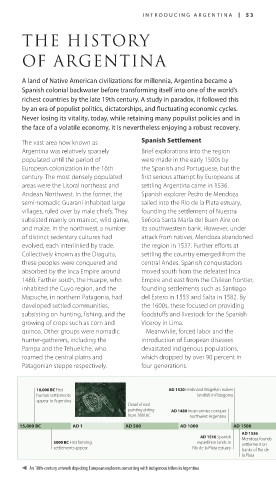
10,000 BC First AD 1520 Ferdinand Magellan makes
human settlements landfall in Patagonia
appear in Argentina
Detail of rock
painting dating AD 1480 Incan armies conquer
from 7000 BC northwest Argentina
15,000 BC AD 1 AD 500 AD 1000 AD 1500
AD 1536
AD 1516 Spanish Mendoza founds
5000 BC First farming expedition lands in settlement on
settlements appear Río de la Plata estuary banks of Río de
la Plata
An 18th-century artwork depicting European explorers consorting with indigenous tribes in Argentina
052-053_EW_Argentina.indd 53 05/08/16 10:04 am

