


Page 57 - (DK Eyewitness) Travel Guide - Argentina
P. 57
THE HIST OR Y OF ARGENTINA 55
mostly pro-free trade, and Spanish-born
traditio nalists, who defended Spain’s
mono poly. International events sharpened
differences. Wars in North America and
Europe saw Great Britain enforce blockades
of the Atlantic, disrupting connections
between metropole and colonies. With
Spanish ships unable to reach the
viceroyalty, illegal trade with non-Spanish
merchants grew, prompt ing increasing calls
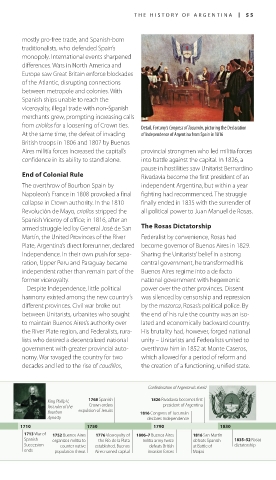
from criollos for a loosening of Crown ties. Detail, Fortuny’s Congress of Tucumán, picturing the Declaration
At the same time, the defeat of invading of Independence of Argentina from Spain in 1816
British troops in 1806 and 1807 by Buenos
Aires militia forces increased the capital’s provincial strong men who led militia forces
confidence in its ability to stand alone. into battle against the capital. In 1826, a
pause in hosti lities saw Unitarist Bernardino
End of Colonial Rule Rivadavia become the first president of an
The overthrow of Bourbon Spain by independent Argentina, but within a year
Napoleon’s France in 1808 provoked a final fighting had recommen ced. The struggle
collapse in Crown authority. In the 1810 finally ended in 1835 with the surrender of
Revolución de Mayo, criollos stripped the all political power to Juan Manuel de Rosas.
Spanish Viceroy of office; in 1816, after an
armed struggle led by General José de San The Rosas Dictatorship
Martín, the United Provinces of the River Federalist by convenience, Rosas had
Plate, Argentina’s direct forerunner, declared become governor of Buenos Aires in 1829.
Indepen dence. In their own push for sepa- Sharing the Unitarists’ belief in a strong
ration, Upper Peru and Paraguay became central government, he trans formed his
independent rather than remain part of the Buenos Aires regime into a de facto
former viceroyalty. national govern ment with hege monic
Despite Independence, little political power over the other prov inces. Dissent
harmony existed among the new coun try’s was silenced by censor ship and repres sion
different provinces. Civil war broke out by the mazorca, Rosas’s poli tical police. By
between Unitarists, urbanites who sought the end of his rule the country was an iso-
to maintain Buenos Aires’s authority over lated and economi cally back ward country.
the River Plate region, and Federalists, rura- His bru tality had, however, forged national
lists who desired a decen tralized natio nal unity – Unitarists and Federalists united to
govern ment with greater pro vin cial auto- over throw him in 1852 at Monte Caseros,
nomy. War ravaged the coun try for two which allowed for a period of reform and
decades and led to the rise of caudillos, the creation of a functioning, unified state.
Confederation of Argentina’s shield
King Philip V, 1768 Spanish 1826 Rivadavia becomes first
first ruler of the Crown orders president of Argentina
Bourbon expulsion of Jesuits 1816 Congress of Tucumán
dynasty declares Independence
1710 1750 1790 1830
1713 War of 1752 Buenos Aires 1776 Viceroyalty of 1806–7 Buenos Aires 1816 San Martín
Spanish organizes militia to the Río de la Plata militia army twice defeats Spanish 1835–52 Rosas
Succession counter native established. Buenos defeats British at Battle of dicta torship
ends population threat Aires named capital invasion forces Maipú
054-055_EW_Argentina.indd 55 05/08/16 10:04 am

