


Page 59 - (DK Eyewitness) Travel Guide - Argentina
P. 59
THE HIST OR Y OF ARGENTINA 57
many problems: wealth was poorly living condi tions were desperate. Their
distributed and interior pro vinces had plight, and their potential as a social
become increasingly distant from Buenos and poli tical force, went unrecognized
Aires and the Pampas, both economically until the emergence of an obscure army
and socially. Crowding in general, Juan Domingo Perón,
cities was a problem, and who went on to become one
poor health and econo mic of the most influential figures
exploi tation were common. in Argentinian history.
Such dis pa ri ties provoked
uprisings and demands for The Rise of Perón
greater political represen ta Juan Perón gained influence
tion. In 1916, the newly and power between 1943 and
formed Unión Cívica Radical 1945 through his alliance with
(Radical Party) won power, Argentinian labor unions. He
marking the advent of popu became Vice President and
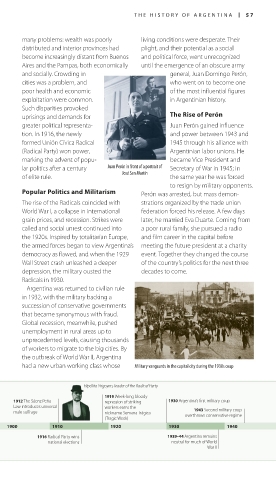
lar politics after a century Juan Perón in front of a portrait of Secretary of War in 1945; in
of elite rule. José San Martín the same year he was forced
to resign by mili tary oppo nents.
Popular Politics and Militarism Perón was arrested, but mass demon
The rise of the Radicals coincided with strations organized by the trade union
World War I, a collapse in inter natio nal fede ra tion forced his release. A few days
grain prices, and reces sion. Strikes were later, he married Eva Duarte. Coming from
called and social unrest continued into a poor rural family, she pursued a radio
the 1920s. Inspired by totali tarian Europe, and film career in the capital before
the armed forces began to view Argentina’s meeting the future president at a charity
democracy as flawed, and when the 1929 event. Together they changed the course
Wall Street crash unleashed a deeper of the country’s politics for the next three
depression, the military ousted the decades to come.
Radicals in 1930.
Argentina was returned to civilian rule
in 1932, with the mili tary backing a
succession of conservative govern ments
that became synony mous with fraud.
Global reces sion, mean while, pushed
unem ploy ment in rural areas up to
unpreceden ted levels, causing thou sands
of workers to migrate to the big cities. By
the out break of World War II, Argentina
had a new urban working class whose Military vanguards in the capital city during the 1930s coup
Hipólito Yrigoyen, leader of the Radical Party
1919 Weeklong bloody
1912 The Sáenz Peña repression of striking 1930 Argentina’s first military coup
Law introduces uni versal workers earns the
1943 Second military coup
male suffrage nickname Semana Trágica overthrows conservative regime
(Tragic Week)
1900 1910 1920 1930 1940
1916 Radical Party wins 1939–44 Argentina remains
national elections neutral for much of World
War II
056-057_EW_Argentina.indd 57 05/08/16 10:04 am

