


Page 62 - All About History - Issue 72-18
P. 62
Frankincense and Myrrh
by the thousands of traders who bought, sold and
distributed their wares from distant China, across
Palmyra/Tadmur
SYRIA the gigantic Central Asian steppe, into the Middle
East and, eventually, to Europe.
Everywhere, throughout the regions, there is
Nabataean Kingdom c.60 BCE
evidence of this trade. The bright blue stones
Damascus Land Route
SEA in Tutankhamen‘s mask (14th century BCE) are
Sea Route lapis lazuli, which came from Afghanistan; and
Nabataean site/remains the oldest silk found in Egypt (which had to have
come from China) was discovered on a mummy
Jerash in the Valley of the Kings, dating from 1070 BCE.
Bosra
Silk scarves dyed in India became the headscarves
Jerusalem
of tribal women who lived along the Black Sea in
Asia Minor. Silk Road trade changed and enhanced
Gaza Kaf the lives of everyone in the regions around it.
Silk Road trade was further enhanced by the
Al-Arīsh
Persian Empire which created the Royal Road
(5th century BCE) that ran for nearly 1,800 miles
Arsinoe/Clysma
(Suez) across Asia. The links between east and west were
Petra further strengthened during Alexander the Great’s
ARABIA campaign in the 4th century BCE, and it was at
Ayla this time that Petra became the capital city of the
(Aqaba) Nabataean Kingdom.
EGYPT Dawmat
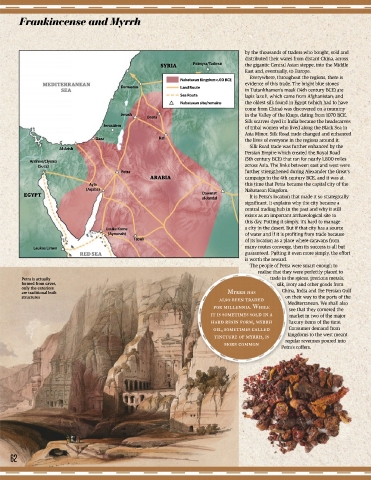
al-Jandal It is Petra’s location that made it so strategically
significant. It explains why the city became a
central trading hub in the past and why it still
exists as an important archaeological site to
this day. Putting it simply, it’s hard to manage
Leuke Kome a city in the desert. But if that city has a source
(Aynunah) of water and if it is profiting from trade because
Tabuk of its location as a place where caravans from
Leukos Limen many routes converge, then its success is all but
RED SEA guaranteed. Putting it even more simply, the effort
is worth the reward.
The people of Petra were smart enough to
th t th y were perfectly placed to
realise that they
li
he spices, precious metals,
Petra is actually trade in th
formed from caves, silk, ivo
ory and other goods from
only the exteriors
na, India and the Persian Gulf
are traditional built Myrrh has Chin
n their way to the ports of the
structures on
also been traded
Mediterranean. We shall also
M
for millennia. While
s
see that they cornered the
it is sometimes sold in a market in two of the major
m
hard resin form, myrrh l uxury items of the time.
C
oil, sometimes called Consumer demand from
ki ingdoms to the west meant
tincture of myrrh, is
reg
gular revenues poured into
more common
a’s coffers.
Petra
62

