


Page 63 - All About History - Issue 72-18
P. 63
Empire of Aromatics
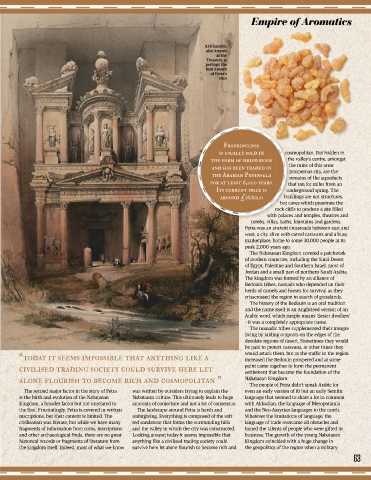
Al-Khazneh,
also known
as the
Treasury, is
perhaps the
best known
of Petra’s
sites
Frankincense
s
is usually sold in co smopolitan. But hidden in
he valley’s centre, amongst
th
the form of dried resin
t he ruins of this once
and has been traded in
p
prosperous city, are the
the Arabian Peninsula
r
remains of the aqueducts
for at least 6,000 years. th
hatranformilesfroman
nderground spring. The
Its current price is un
around £36/kilo bui ildings are not structures,
but c aves which penetrate the
rock cli ffs to produce a site filled
es and temples, theatres and
with palace
tombs, villas, baths, fountains and gardens.
Petra was an ancient crossroads between east and
west,acityalivewithcamelcaravansandabusy
marketplace,hometosome30,000peopleatits
peak 2,000 years ago.
The Nabataean Kingdom covered a patchwork
of modern countries, including the Sinai Desert
of Egypt, Palestine and Southern Israel, most of
Jordan and a small part of northern Saudi Arabia.
Thekingdom wasformedbyanallianceof
Bedouin tribes, nomads who depended on their
herds of camels and horses for survival as they
crisscrossed the region in search of grasslands.
The history of the Bedouin is an oral tradition
and the name itself is an Anglicised version of an
Arabic word, which simply means ‘desert dwellers’
– it was a completely appropriate name.
The nomadic tribes supplemented their meagre
livingbyraidingoutpostsontheedgesofthe
desolate regions of desert. Sometimes they would
be paid to protect caravans, at other times they
wouldattackthem,butasthetrafficintheregion
“today it seems impossible that anything like a increased the Bedouin prospered and at some
point came together to form the permanent
civilised trading society could survive here let
settlement that became the foundation of the
Nabataean Kingdom.
alone flourish to become rich and cosmopolitan ”
The people of Petra didn’t speak Arabic (or
The second major factor in the story of Petra was written by outsiders trying to explain the even an early version of it) but an early Semitic
is the birth and evolution of the Nabataean Nabataean culture. This ultimately leads to huge language that seemed to share a lot in common
Kingdom, a broader factor but not unrelated to amounts of conjecture and not a lot of consensus. with Akkadian, the language of Mesopotamia
the first. Frustratingly, Petra is covered in written The landscape around Petra is harsh and and the Neo-Assyrian languages to the north.
inscriptions, but their context is limited. The unforgiving. Everything is composed of the soft Whatever the limitations of language, the
civilisation was literate, but while we have many red sandstone that forms the surrounding hills language of trade overcame all obstacles and
fragments of information from coins, inscriptions and the valley in which the city was constructed. honed the talents of people who were gifted in
and other archaeological finds, there are no great Looking around today it seems impossible that business. The growth of the young Nabataean
historical records or fragments of literature from anything like a civilised trading society could Kingdom coincided with a huge change in
the kingdom itself. Indeed, most of what we know survive here let alone flourish to become rich and the geopolitics of the region when a military
63

