


Page 67 - All About History - Issue 72-18
P. 67
Empire of Aromatics
watering holes. It was a simple but effective Roman Empire that was to be their undoing.
The towering Ad-Deir, also
known as the Monestary strategy. Diodorus, the Greek writer of the 1st Although there are no historical accounts or oral
century BCE, wrote: “Neither the Assyrians of traditions of any great clashes by the armies of
old, nor the king of the Medes and Persians, nor the Nabataeans in the region, we do know that
yet those of the Macedonians have been able to by 107 CE, there were Roman military outposts
enslave them, and [...] They never brought their in the kingdom, after which it became known as
Arabia Petraea. It w
sion. Adding
attempts to successful conclusion.” Adding Arabia Petraea. It was about this time, in 106
eptionally
that the Nabataeans were “exceptionally CE, that the
CE, that the last King of the Nabataeans
fond of freedom”. died. Rabbel II seems to have had
died. Ra
In
It should be noted that the an heir but he never took the
an he
2007 there
thr
Nabataean Kingdom fought throne. It could well have been
was a global poll
that the lack of an obvious/
against a number of foes and th
expanded under a number to find the ‘new’ Seven strong successor, linked
st
of their kings. That’s not to Wonders of the World, t to a kingdom increasingly
d
say they won every battle, and Petra was chosen by dependent on the much
but they were certainly a r richer Roman Empire, led to
popular vote. Ironically
a peaceful or administrative
force to be reckoned with, a
it could have qualified
despite the fact that they tak
takeover, rather than one by
mili
were on the edges of two large e for the original military force.
ed
empires. The Nabataeans feuded list Wh
While it wasn’t quite the most
with the Persians on a number of easterly territory of the Roman
rof
easterlyt
occasions, but it was the ever-growing Empire, Arabia Petraea was absolutely
Empire, Arabi
growing
a frontier land. A change in leadership and the
integration of these lands into Roman territories
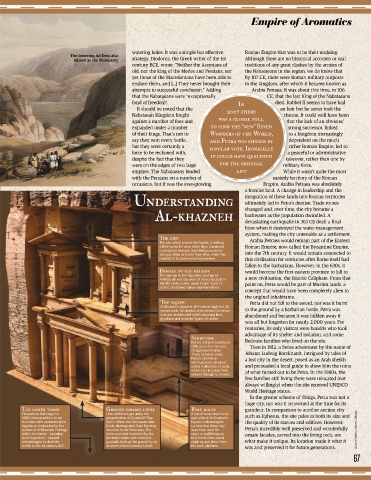
Understanding ultimately led to Petra’s demise. Trade routes
changedand,overtime,thecitybecamea
Al-khazneh backwater as the population dwindled. A
devastating earthquake in 363 CE dealt a final
blow when it destroyed the water management
system, making the city untenable as a settlement.
The urn Arabia Petraea would remain part of the Eastern
The urn, which crowns the façade, is looking
alittleworseforwearthesedays.Convinced Roman Empire, now called the Byzantine Empire,
it contained treasure, local Bedouin used to
takepotshotsatitwiththeirrifles,whichhas into the 7th century. It would remain connected to
resulted in its pockmarked appearance. this civilisation for centuries after Rome itself had
fallen to the barbarians. However, in the 630s, it
Damage to the reliefs would become the first eastern province to fall to
The damage to the figurative carvings on
Al-Khazneh was the work of the iconoclasts in a new civilisation, the Islamic Caliphate. From that
the8thcenturywho,underCaliph YazidII’s pointon,PetrawouldbepartofMuslimlands,a
orders, destroyed human representations.
concept that would have been completely alien to
the original inhabitants.
The façade Petra did not fall to the sword, nor was it burnt
Al-Khazneh’s façade is 39.6 metres high and 28
metreswide.ItsclassicalstyleutilisesCorinthian to the ground by a barbarian horde. Petra was
columns and detailed reliefs depicting lions, abandoned and because it was hidden away it
gryphonsandsculptedfiguresofdeities.
was all but forgotten for nearly 2,000 years. For
centuries, its only visitors were bandits who took
advantage of its shelter and isolation, and some
Sandstone
Petra’s red-pink sandstone Bedouin families who lived on the site.
cliffs are rich in iron and Then in 1812, a Swiss adventurer by the name of
manganese minerals.
These minerals create Johann Ludwig Burckhardt, intrigued by tales of
Petra’s distinctive alostcityinthedesert,posedasanArabsheikh
red-hued rock, streaked
with a multiplicity of veins, andpersuadedalocalguidetoshowhimtheruins
which vary in colour from ofwhatturnedouttobePetra.Inthe1980s,the
yellows through to browns.
few families still living there were relocated (not
always willingly) when the site received UNESCO
World Heritage status.
In the greater scheme of things, Petra was not a
huge city, nor was it renowned at the time for its
The lower tombs Ground surface level Bore holes grandeur. In comparison to another ancient city
Excavationsthatbegunin Howdidtombsgetunderthe A line of bore holes frame
2003 discovered four burial ground below Al-Khazneh? They each side of Al-Khazneh’s such as Ephesus, the site pales in both its size and
chambers with pediment-style didn’t. When the Nabataean dam façade. Archaeologists thequalityofitsstatuesandedifices.However,
façades six metres below the finally disintegrated, flash flooding surmise that these may
surfaceofAl-Khazneh.Findings returned to the Petra area. The have been used for Petra’s incredibly well preserved and wonderfully © David Roberts; Welcome Collection
withinthetombs–including stone and sand deposited by the stairs or scaffolding so ornate facades, carved into the living rock, are
bone fragments – allowed torrential waters over centuries that the builders could
archaeologists to date the gradually built up the ground by six climb up and down from what make it unique. Its location made it what it
tombstothe1stcenturyBCE. or seven metres to today’s level. the work platform.
wasandpreserveditforfuturegenerations.
67

