


Page 70 - All About History - Issue 72-18
P. 70
Propaganda
inrich Hoffman, was drafted
TOO He the last minute.
in t
to redevelop the exhibition
at t
DEGENERATE wr rath of the Führer, Goebbels
Dismayed at incurring the
D
im
agined a completely new
TO EXHIBIT kin unter-exhibition to Great
nd of show to serve as a
co
erman Art. Desperate to
Ge
Of all those showcased in the reg
gain Hitler’s favour, Goebbels
exhibition, one very vocal anti-Nazi pi tched an exhibition of
egenerate art to highlight the
artist was conspicuously absent… de
di sparity between ‘traitorous’
Unashamedly anti-Nazi, John Heartfield was an
nd ‘patriotic’ art. The idea
one of Hitler’s biggest critics and at one point
went down a storm, and on 29
was fifth on the Gestapo’s most-wanted list – so w
une Hitler officially gave his
it’s remarkable that this local dissenter didn’t Ju
feature in the exhibition at all. se
eal of approval.
Born to German parents as Helmund The next day, Goebbels
Herzfeld in the late-19th century, he was called ap
ppointed Adolf Ziegler –
up to fight in World War I in September 1914.
Hitler’s favourite painter and
Convinced at the futility of war, however, H
ater known as the ‘Master of
Herzfeld feigned a mental breakdown and la
was dismissed from military service. It was G
German Pubic Hair’ for his
impossible, he believed, to fight in a war that nude paintings – to head up
n
he deemed the greatest insanity of all. As anti-
British sentiment swept Germany, he chose to Ernst Ludwig Kirchner’s a nationwide purge of the
galleries, confiscating any
Anglicise his name and became known as John 1913 painting The Street g
Heartfield. was exhibited at the w
works deemed degenerate.
Upon moving to the capital, Heartfield Degenerate Art show Ziegler was only too happy to
Z
became involved in the Berlin Dada scene, c
comply, expelling thousands
where he came to the realisation that creating
o
art that wasn’t anti-war was to be complicit in of works of art from the
l
l
i
itler had a means of ridding
the government’s propaganda campaign. helm. inally il h d f i d d i public view, over 650 of which would soon
i
bli
hl
In response, he turned his back on traditional Germany of so-called ‘degenerate’ art, and feature in the Degenerate Art exhibition.
art and embraced photomontage, creating Goebbels was tasked with pruning gallery While works created by any artist deemed
dozens of anti-war, anti-Hitler and anti-Nazi
compositions that were published in several collections, leaving only ‘true’ art. Goebbels, degenerate were rounded up, including works
Communist and anti-fascist magazines. however, didn’t share Hitler’s artistic vision. by Mondrian, Picasso and van Gogh, it was
Heartfield was an integral part of the artistic A divide sprung up in the Nazi Party on the work of German and Germany-based
resistance against the Nazis, but by using the the topic of expressionism – on one side artists that were chosen for this very
press rather than the canvas to voice his disdain stood Goebbels, an enthusiastic patron of public humiliation.
for the regime, he ensured that he wasn’t an
easy figure to attack. After all, Heartfield’s expressionist painters, and on the other In a matter of just two weeks, the
press-published collages were impossible to loomed the prominent Nazi theorist Alfred exhibition was planned in its entirety. Held
round up and destroy; they could just as easily Rosenberg, who saw expressionism as the in Munich’s Institute of Archaeology in the
return with a vengeance.
decay of humanity. After a year of fierce Hofgarten, the Degenerate Art exhibition
feuding, the matter was resolved when
John Heartfield’s collage entitled Don’t be
Frightened – He’s a Hitler finally sided with Rosenberg,
Vegetarian, depicting condemning expressionism as the
Hitler as a butcher
eyeing up the antithesis of Nazi ideology.
French cockerel In celebration of Nazi-approved art, the
Ministry of Public Enlightenment and
Propaganda planned a brand-new annual
exhibit, the Great German Art exhibition,
intended to celebrate the ‘true’ artists of
the Third Reich. Artists were invited to
submit their works to a judging panel and
of the thousands of submissions, over
600 artworks were chosen to feature. In
the weeks leading up to this illustrious
exhibition, however, Hitler visited Munich’s
House of Art, where the exhibition was to
be held. The visit did not go to plan, with
Goebbels later writing that Hitler was “wild
with rage” at the selection. The judges
were dismissed, and Hitler’s photographer,
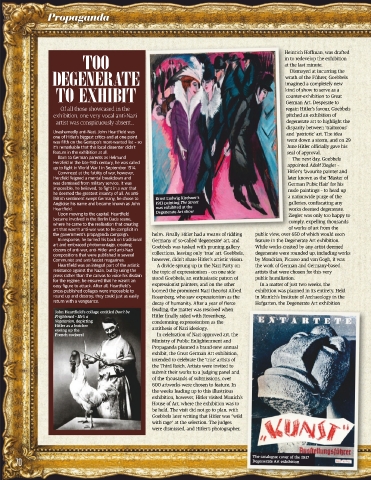
70 The catalogue cover of the 1937
Degenerate Art exhibition

