


Page 79 - All About History - Issue 72-18
P. 79
Battle of Raphia


          On his way south Antiochus accepted the submission
          of several cities and towns, including Aradus,               SELEUCIDEMPIRE                                      PTOLEMAICEGYPT
          Philoteria, Scythopolis, and Gaddara. He captured
          Atabyrium and Rabbatamana. Several higher-ranking
          Ptolemaicofficersdefectedtohimashisawe-                              NUMBER OF INFANTRY                                    NUMBER OF INFANTRY
          inspiring army approached the borders of Egypt.
             As Hellenistic successor states of the vaunted
          Alexander’s grand empire, both largely adhered to
          the military system that the Macedonian conqueror
          had perfected. At the heart of both the Seleucid and
          the Ptolemaic armies was the infantry phalanx.
             Each soldier, or phalangite, was armed with a                                  NUMBER OF CAVALRY                                      NUMBER OF CAVALRY
          sarissa,anextremelylongpikethatcouldbeas
          much as 20 feet in length. When arrayed in lines,
          the business end of the weapons held by the men of
          the first five lines projected ahead of the phalangite
          of the first line. This meant that the Hellenistic
          phalanx presented an almost impenetrable hedge of        NUMBER OF ELEPHANTS (INDIAN)                          NUMBER OF ELEPHANTS (AFRICAN FOREST)
          degree of training to be effective, since it was no 102                                                        73
          spearpoints against an opponent.
             Phalanxes tended to be relatively immobile,
          andmostoftenbettersuitedforeitherdefenceor
          a deliberate advance. They also required a high


          easy thing to manoeuvre with a giant spear in close
          proximity to other soldiers. Both the Seleucids and
          the Ptolemies favoured using Macedonian men who                               ANTIOCHUS                                             PTOLEMY IV
          were the descendants of Alexander’s soldiers who                              III                                                   Young Ptolemy IV led a
          had settled in their empires a century beforehand.                                                                                  debauched lifestyle but managed
                                                                                        Young Antiochus III was                               to rebuilt the Egyptian army
          It was something of a novelty when Ptolemy IV
                                                                                        determined to restore the empire                      when Antiochus’s intentions
          recruitednativeEgyptianstoserveasphalangitesin
                                                                                        of his forefathers to glory.                          became clear.
          the run-up to the Raphia campaign.                                            His main opponent would be                              Reacted quickly when the
             Bothsidesstakedhugeimportanceontheircorps                                  Ptolemy IV of Egypt.                           LEADER  Seleucid threat became apparent
          of war elephants. The Seleucids, with their territories                LEADER    Brave and determined                                 Youngandpaid toolittle
          abutting India, acquired their animals from that                                 Youthful and inexperienced                         attention to statecraft
          land. A treaty between Seleucus I and Chandragupta
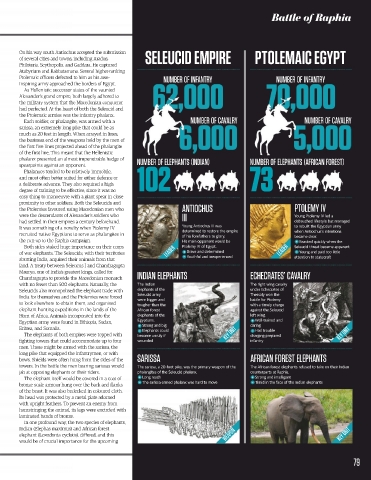
          Maurya, one of India’s greatest kings, called for        INDIAN ELEPHANTS                                      ECHECRATES’ CAVALRY
          Chandragupta to provide the Macedonian monarch
          with no fewer than 500 elephants. Naturally, the         The Indian                                            The right wing cavalry
          Seleucids also monopolised the elephant trade with       elephants of the                                      under Echecrates of
                                                                   Seleucid army                                         Thessaly won the
          India for themselves and the Ptolemies were forced
                                                                   were bigger and                                       battle for Ptolemy
          to look elsewhere to obtain them, and organised          tougher than the                                      with a timely charge
          elephant hunting expeditions in the lands of the         African forest                                        against the Seleucid
          Horn of Africa. Animals incorporated into the            elephants of the                                      left wing.
                                                                   Egyptians.                                              Well-trained and
          Egyptian army were found in Ethiopia, Sudan,
                                                                     Strong and big                                      daring
          Eritrea, and Somalia.
                                                                     Elephants could                         KEY UNIT      Had trouble                              KEY UNIT
             The elephants of both empires were topped with        become unruly if                                      charging prepared
          fighting towers that could accommodate up to four        wounded                                               infantry
          men.Thesemightbearmedwiththesarissa,the
          long pike that equipped the infantrymen, or with
          bows. Shields were often hung from the sides of the      SARISSA                                               AFRICAN FOREST ELEPHANTS
          towers.Inthebattlethemenbearingsarissaswould             Thesarissa,a20-footpike,wastheprimaryweaponofthe      The African forest elephants refused to take on their Indian
          jab at opposing elephants or their riders.               phalangites of the Seleucid phalanx.                  counterparts at Raphia.
             Theelephantitselfwouldbecoveredinacoatof                Long reach                                            Strong and intelligent
                                                                     The sarissa-armed phalanx was hard to move            Timid in the face of the Indian elephants
          bronze scale armour hung over the back and flanks
          of thebeast.Itwas also bedecked in colouredcloth.
          Its head was protected by a metal plate adorned
          withuprightfeathers.Topreventanenemyfrom
          hamstringing the animal, its legs were encircled with
          laminated bands of bronze.
             In one profound way, the two species of elephants,
          Indian (Elephas maximus) and African forest
          elephant (Loxodonta cyclotis), differed, and this                                                  WEAPON                                                 KEY UNIT
          wouldbeofcrucialimportancefortheupcoming


                                                                                                                                                                           79

