


Page 78 - All About History - Issue 72-18
P. 78
Greatest Battles


                                                                “Phalanxes tended to be relatively immobile, and

                                                                                                  most often better suited for either

                                                                                                    defence or a deliberate advance”


                                                                Asia Minor and instead tear away a big hunk of the     to inducting 20,000 native Egyptian men into the
                                                                Ptolemaic Empire. Ptolemy IV now had to contend        army, something that had hitherto been avoided by
                                                                with the consequences of his poor treatment of         the originally Macedonian dynasty.
                                                                Theodotus,aswellasthose that attendedthepoor             To gain time for all of this recruiting and training,
                                                                governanceofhisdynasty.Inthewakeofthe                  Ptolemyhadhisseniorministers,Agathocles
                                                                successful Third Syrian War, in which the Ptolemaic    and Sosibius, stall for time. Exploiting Antiochus’
                                                                frontiers had been flung out far from Egypt’s          assumption that Ptolemy IV had no stomach for
                                                                borders, the administration of that country had        war, the ministers made it known that a negotiated
                                                                suffered. Even worse, the army had been allowed to     settlement was possible, despite Antiochus’s
                                                                decline in prowess and was no match for that of the    clear-cut theft of Seleucia Pieria. They met with
                                                                Seleucids. With Theodotus’ treason – the Aetolian      Seleucidenvoys intheEgyptiancityofMemphis
                                                                generalhadtakenhissoldiers overtotheAntiochus          in the south of the Nile Delta. Meanwhile, feverish
                                                                with him – Coele Syria itself was undefended.          Ptolemaic military preparations were taking place
                                                                   Ptolemy set about rebuilding his army by            outofSeleucidsightinthecityofAlexandriaonthe
                                                                recruiting soldiers from wherever he could find        Mediterranean coast throughout 218 BCE.
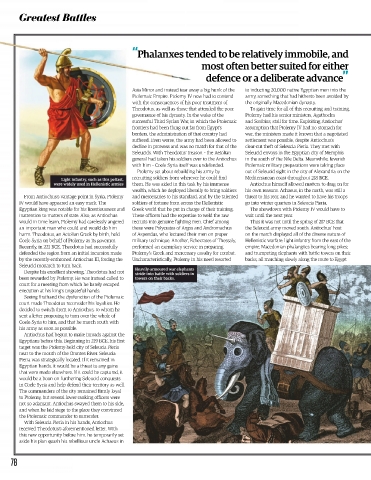
                              Light infantry, such as this peltast,
                           were widely used in Hellenistic armies  them.Hewas aidedinthistaskbyhisimmense                Antiochus himself allowed matters to drag on for
                                                                wealth, which he deployed liberally to bring soldiers  his own reasons. Achaeus, in the north, was still a
             FromAntiochus’svantagepointinSyria,Ptolemy         and mercenaries to his standard, and by the talented   threat to his rear, and he wanted to have his troops
          IV would have appeared an easy mark. The              soldiers of fortune from across the Hellenistic        go into winter quarters in Seleucia Pieria.
          Egyptian king was notable for his licentiousness and  Greekworldthatheputinchargeoftheirtraining.              The showdown with Ptolemy IV would have to
          inattention to matters of state. Also, as Antiochus   These officers had the expertise to weld the raw       wait until the next year.
          wouldintimelearn,Ptolemyhadcarelesslyangered          recruits into genuine fighting men. Chief among          Thus it was not until the spring of 217 BCE that
          an important man who could and would do him           thesewerePolycratesofArgosandAndromachus               the Seleucid army moved south. Antiochus’ host
          harm.Theodotus,anAetolianGreekbybirth,held            of Aspendus, who lectured their men on proper          on the march displayed all of the diverse nature of
          Coele Syria on behalf of Ptolemy as its governor.     military technique. Another, Echecrates of Thessaly,   Hellenistic warfare: light infantry from the east of the
          Recently,in221BCE,Theodotushadsuccessfully            performed an exemplary service in preparing            empire;Macedonianphalangitesbearinglongpikes;
          defended the region from an initial incursion made    Ptolemy’s Greek and mercenary cavalry for combat.      and trumpeting elephants with battle towers on their
          by the recently-enthroned Antiochus III, forcing the  Uncharacteristically, Ptolemy in his need resorted     backs, all marching slowly along the route to Egypt.
          Seleucidmonarchtoturnback.
                                                                  Heavily-armoured war elephants
             Despitehisexcellentshowing,Theodotushadnot
                                                                  stride into battle with soldiers in
          been rewarded by Ptolemy. He was instead called to      towers on their backs.
          court for a meeting from which he barely escaped
          execution at his king’s ungrateful hands.
             Seeing firsthand the dysfunction of the Ptolemaic
          courtmadeTheodotusreconsiderhisloyalties.He
          decidedtoswitchthemtoAntiochus,towhomhe
          sent a letter proposing to turn over the whole of
          Coele Syria to him, and that he march south with
          hisarmyassoonaspossible.
             Antiochus had begun to make inroads against the
          Egyptiansbeforethis.Beginningin219BCE,hisfirst
          target was the Ptolemy-held city of Seleucia Pieria
          near to the mouth of the Orontes River. Seleucia
          Pieria was strategically located. If it remained in
          Egyptian hands, it would be a threat to any gains
          that were made elsewhere. If it could be captured, it
          would be a boon on furthering Seleucid conquests
          in Coele Syria and help defend their territory as well.
          Thecommandersofthecityremainedfirmlyloyal
          to Ptolemy, but several lower-ranking officers were
          not so adamant. Antiochus swayed them to his side,
          andwhenhelaidsiege totheplacetheyconvinced
          the Ptolemaic commander to surrender.
             With Seleucia Pieria in his hands, Antiochus
          received Theodotus’s aforementioned letter. With
          this new opportunity before him, he temporarily set
          aside his plan quash his rebellious uncle Achaeus in


      78

