


Page 80 - All About History - Issue 72-18
P. 80
Greatest Battles


          to roughly ten feet for the the Indian elephant. It  214 BCE
          engagement at Raphia. The African forest elephant
          was utterly unwilling to close with its Indian cousin.
          It was a significantly smaller animal, standing
          around sevent o eight feet in height as opposed

          should be borne in mind also that the African forest     Elephants, mercenaries and phalanxes
          elephant is not the same creature as the better-         of troops armed with sarissas take to
          known African bush elephant (Loxodonta africana),        the field in the Battle of Raphia
          which is larger than the Indian but untameable.
             The African forest elephant’s reluctance to fight
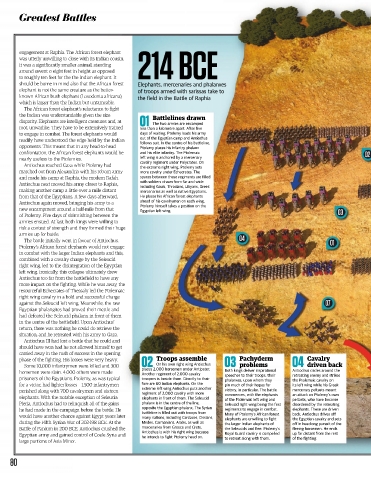
          the Indian was understandable given the size                    Battlelines drawn
          disparity. Elephants are intelligent creatures and, at    01    The two armies are encamped
          root, unwarlike. They have to be extensively trained      less than a kilometre apart. After five
          to engage in combat. The forest elephants would           days of waiting, Ptolemy leads his army
                                                                    out of the Egyptian camp and Antiochus
          readily have understood the edge held by the Indian
                                                                    follows suit. In the centre of his battleline,
          opponents. This meant that in any head-to-head            Ptolemy places his infantry phalanx
          confrontation, the African forest elephants would be      and his elite infantry. The Ptolemaic                                                                       02
          nearly useless to the Ptolemies.                          left wing is anchored by a mercenary
                                                                    cavalry regiment under Polycrates. On
             Antiochus reached Gaza while Ptolemy had
                                                                    the extreme right wing, Ptolemy sets
          marched out from Alexandria with his reborn army          more cavalry under Echecrates. The
          and made his camp at Raphia, the modern Rafah.            spaces between these regiments are filled
                                                                    with soldiers drawn from far and wide
          Antiochus next moved his army closer to Raphia,
                                                                    including Gauls, Thracians, Libyans, Greek
          making another camp a little over a mile distant          mercenaries as well as native Egyptians.
          from that of the Egyptians. A few days afterward,         He places his African forest elephants
                                                                    ahead of his cavalrymen on each wing.
          Antiochus again moved, bringing his army to a
                                                                    Ptolemy himself takes a position on the
          new encampment around a half-mile from that               Egyptian left wing.                                                                            03
          of Ptolemy. Five days of skirmishing between the
          armies ensued. At last, both kings were willing to
          risk a contest of strength and they formed their huge
          armies up for battle.                                                                                     04
             The battle initially went in favour of Antiochus.                                                                                                 01
          Ptolemy’s African forest elephants would not engage
          in combat with the larger Indian elephants and this,
          combined with a cavalry charge by the Seleucid
          right wing, led to the disintegration of the Egyptian
          left wing. Ironically, this collapse ultimately drew
          Antiochus too far from the battlefield to have any
          more impact on the fighting. While he was away, the
          resourceful Echecrates of Thessaly led the Ptolemaic
          right wing cavalry in a bold and successful charge
          against the Seleucid left wing. Meanwhile, the raw                                                                                                 07
          Egyptian phalangites had proved their mettle and
          had defeated the Seleucid phalanx in front of them
          in the centre of the battlefield. Upon Antiochus’
          return, there was nothing he could do retrieve the
          situation, and he retreated with his army to Gaza.
             Antiochus III had lost a battle that he could and
          should have won had he not allowed himself to get
          carried away in the rush of success in the opening
          phase of the fighting. His losses were very heavy.         02     Troops assemble                         Pachyderm                       Cavalry
             Some 10,000 infantrymen were killed and 300                    On his own right wing Antiochus   03  problems                   04  driven back
                                                                     places 2,000 horsemen under Antipater.   Both kings deliver inspirational   Antiochus circles around the
          horsemen were slain. 4,000 others were made
                                                                     Another regiment of 2,000 cavalry       speeches to their troops, their   retreating enemy and strikes
          prisoners of the Egyptians. Ptolemy, as was typical        troopers is beside them. Directly to their
                                                                                                             phalanxes, upon whom they       the Ptolemaic cavalry on
          for a victor, had lighter losses – 1,500 infantrymen       fore are 60 Indian elephants. On the    pin much of their hopes for     its left wing while his Greek
                                                                     extreme left wing Antiochus puts another
          perished along with 700 cavalrymen and sixteen                                                     victory, in particular. The battle   mercenary peltasts mount
                                                                     regiment of 2,000 cavalry with more     commences, with the elephants   an attack on Ptolemy’s own
          elephants. With the notable exception of Seleucia          elephants in front of them. The Seleucid   of the Ptolemaic left wing and   peltasts, who have become
          Pieria, Antiochus had to relinquish all of the gains       phalanx is in the centre of the line,   Seleucid right wing being the first   disordered by the retreating
                                                                     opposite the Egyptian phalanx. The Syrian
          he had made in the campaign before the battle. He                                                  regiments to engage in combat.   elephants. These are driven
                                                                     battleline is filled out with troops from
          would have another chance against Egypt years later        many nations, including Cardaces, Cissians,   Many of Ptolemy’s African forest   back. Antiochus drives off
                                                                                                                                             the Egyptian cavalry and sets
                                                                                                             elephants are unwilling to fight
          during the Fifth Syrian War of 202-198 BCE. At the         Medes, Carmanians, Arabs, as well as    the larger Indian elephants of   off in headlong pursuit of the
          Battle of Panium in 200 BCE, Antiochus crushed the         mercenaries from Greece and Crete.      the Seleucids and flee. Ptolemy’s   fleeing horsemen. He ends
                                                                     Antiochus is with his right wing because
          Egyptian army and gained control of Coele Syria and                                                Royal Guard cavalry is compelled   up far distant from the rest
                                                                     he intends to fight Ptolemy head on.    to retreat along with them.     of the fighting.
          large portions of Asia Minor.

      80

