


Page 119 - DK Eyewitness Travel Guides - The World's Must-See Places
P. 119
ITALY 117
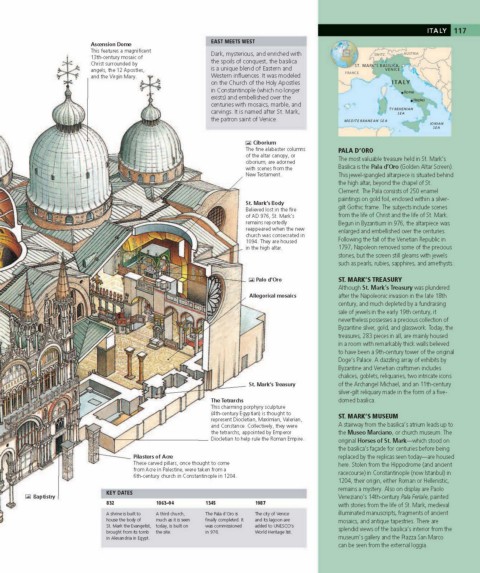
EAST MEETS WEST
Ascension Dome
This features a magnificent Dark, mysterious, and enriched with
13th-century mosaic of ~
Christ surrounded by the spoils of conquest, the basilica ST. MAt 'S BASILICA, p. !.-A-.1
angels, the 12 Apostles, is a unique blend of Eastern and FRANCE VENICE ....
~ ......
and the Virgin Mary. Western influences. It was modeled
on the Church of the Holy Apostles ITALY
in Constantinople (which no longer eRome
exists) and embellished over the
eNaples
centuries with mosaics, marble, and
carvings. It is named after St Mark, TYRRHENIAN
SEA
the patron saint of Venice. MEDITERRANEAN SEA
IONIAN
SEA
gJ Ciborium
The fine alabaster columns PALA D'ORO
of the altar canopy, or
ci borium, are ad or ned The most valuable treasure held in St Mark's
with scenes from the Basilica is the Pal a d'Oro (Golden Altar Screen)
New Testament This jewel-spangled altarpiece is situated behind
the high altar, beyond the chapel of St.
Clement The Pal a consists of 250 enamel
paintings on gold foi I, enclosed Vliithi n a silver-
St. Mark's Body
Believed lost in the fire gilt Gothic frame. The subjects include scenes
of AD 976, St. Mark's from the I ife of Christ and the I ife of S t Mark.
remains reportedly Begun in Byzantium in 976, the altarpiece was
reappeared when the new enlarged and embellished over the centuries.
church was consecrated in
1094. They are housed Following the tall of the Venetian Republic in
'-..,...,.,._,_- in the high altar. 179 7, Napoleon removed some of the precious
stones, but the>creen still gleams with jewels
such as pearls, rubies, sapphires, and amethysts.
ST_ MARK'S TREASURY
Although St. Mark's Treasury was plundered
Allegorical mosaics after the Napoleonic invasion in the late 18th
century, and much depleted by a tundraising
sale of jewels in the early 19th century, it
nevertheless possesses a precious collection of
Byzantine silver, gold, and glasswork. Today, the
treasures, 283 pieces in all, are mainly housed
in a room with remarkably thick walls believed
to have been a 9th-century tower of the original
Doge's Palace. A dazzling array of exhibits by
Byzantine and Venetian craftsmen includes
chalices, gob I ets, reliquaries, two intricate icons
of the Archangel Michael, and an 11th-century
silver -gilt reliquary made in the form of a five-
The Tetrarchs domed basilica.
This charming porphyry sculpture
(4th-century Egyptian) is thought to
represent Diocletian, Maximian, Valerian, ST_ MARK'S MUSEUM
and Constance. Collectively, they were A stairway from the basilica's atrium leads up to
the tetrarchs, appointed by Emperor the Museo Marciano, or church museum. The
~--,.&.::____ _________ Diocletian to help rule the Roman Empire.
original Horses of St. Mark-which stood on
the basilica's fa<;ade for centuries before being
Pilasters of Acre replaced by the replicas seen today-are housed
These carved pillars, once thought to come here. Stolen from the Hippodrome (and ancient
from Acre in Palestine, were taken from a
6th-century church in Constantinople in 1204. racecourse) in Constantinople (now Istanbul) in
1204, their origin, either Rom an or Hellenistic,
remains a mystery. Also on display are Paolo
KEY DATES
gJ Baptistry Veneziano's 14th-century Pa/a Feria/e, painted
832 1063-94 1345 1987 with stories from the life of St. Mark, medieval
A shrine is built to A third church, The Pala d'Oro is The c~y of Wnice illuminated manuscripts, fragments of ancient
house the body of much as it is seen final~ completed. It and ~s lagoon are mosaics, and antique tapestries. There are
St. Mark the Evangelist, today, is built on was commissioned added to UNESCO's
brought from its tomb the site. in 976. v>.orld Heritage 1&. splendid views of the basilica's interior from the
in Alexandria in Egypt. museum's gallery and the Razza San Marco
can be seen from the external loggia.

