


Page 124 - DK Eyewitness Travel Guides - The World's Must-See Places
P. 124
122  EUROPE                                     Campo dei Miracoli, Pisa

                                                                       Pisa's world-famous Leaning  Tower is just one of the splendid
                                                                       buildings rising from the lawns of the "Field of Miracles." It is
         ~
                                                                       joined by the Duomo, a triumph of marble decoration;  Italy's
            FRANCl   CAMPO  DEl
         "-._   M IRACOLI,  PI SA 0                                    largest baptistry, with an acoustically perfect interior; and  the
         ."~.....-.      - ITALY
                                                                       Campo Santo cemetery, containing Roman sarcophagi and
                            •Rome
                                                                       sculptures.  The buildings combine IVIoorish elements, such as
                                                                       inlaid marble in geometric patterns (arabesques), with delicate
                         TYRRHENIAN
                           SEA
                                                                       Romanesque colonnading and spiked Gothic niches and  pinnacles.
           MEDITERRANEAN SEA
                                     IONIAN
                                      SEA
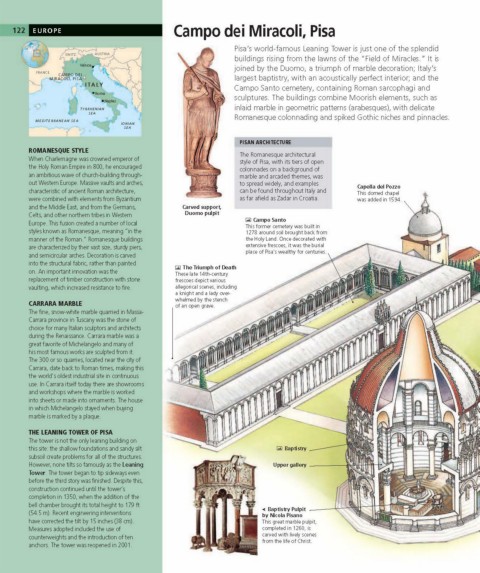
                                                                        PI SAN ARCHITECTURE
         ROMANESQUE STYLE
                                                                        The Romanesque architectural
         When Charlemagne was crowned emperor of
                                                                        style of Pi sa, with its tiers of open
         the Holy Roman Empire in 800, he encouraged
                                                                        colonnades on a background of
         an ambitious wave of church-building through-                  marble and arcaded themes, was
         out Western Europe. Massive vaults and arches,                 to spread widely, and examples     Capella del Pozzo
         characteristic of ancient Roman architecture,                  can be found throughout Italy and   This domed chapel
         were combined with elements from Byzantium                     as far afield as Zadar in Croatia.   was added in 1594.
         and the Middle East, and from the Germans,    Carved support,
         Celts, and other northern tribes in Western    Duomo pulpit
                                                                          ~Campo Santo
         Europe. This fusion created a number of local
                                                                          This former cemetery was built in
         styles known as Romanesque, meaning "in the                      1278 around soil brought back from
         manner of the Roman."  Romanesque buildings                      the Holy Land. Once decorated with
         are characterized by their vast size, sturdy piers,              extensive frescoes, it was  the burial
                                                                          place of Pisa's wealthy for centuries.
         and semicircular arches. Decoration is carved
         into the structural fabric, rather than painted
                                                     ~ The Triumph of Death
         on. k1 important innovation was the         These late 14th-century
         replacement of timber construction with stone   frescoes depict various
         vaulting, which increased resistance to fire.   allegorical scenes, including
                                                     a knight and a lady over-
                                                     whelmed by the stench
         CARRARA MARBLE                              of an open grave.
         The fine, snow-white marble quarried in Massa-
         Carrara province in Tuscany was the stone of
         choice for many Italian sculptors and architects
         during the Renaissance. Carrara marble was a
         great favorite of Michelangelo and many of
         his most famous works are sculpted from it
          The 300 or so quarries, located near the city of
         Carrara, date back to Roman times, making this
         the world's oldest industrial site in continuous
         use. In Carrara itself today there are showrooms
         and workshops where the marble is worked
         into sheets or made into ornaments, The house
         in which Michelangelo stayed when buying
         marble is marked by a plaque.

         THE LEANING TOWER OF PI SA
         The tower is not the only leaning building on
         this site. the shallow foundations and sandy silt
         subsoil create problems for all of the structures.
         However, none tilts so famously as the Leaning
          Tower. The tower began to tip sideways even
         before the third story was finished. Despite this,
         construction continued until the tower's
         completion in 1350, when the addition of the
         bell chamber brought its total height to 179 ft                       ~ Baptistry Pulpit
         (54 5 m)  Recent engineering interventions                            by Nicola Pisano
         have corrected the tilt by 15 inches (38 em)                          This great marble pulpit,
         Measures adopted included the use of                                  completed in 1260, is
                                                                               carved with lively scenes
         counterweights and the introduction of ten
                                                                               from the life of Christ
         anchors. The tower was reopened in 2 00 1.

