


Page 146 - DK Eyewitness Travel Guides - The World's Must-See Places
P. 146
Topkap1 Palace, Istanbul
     144  EUROPE

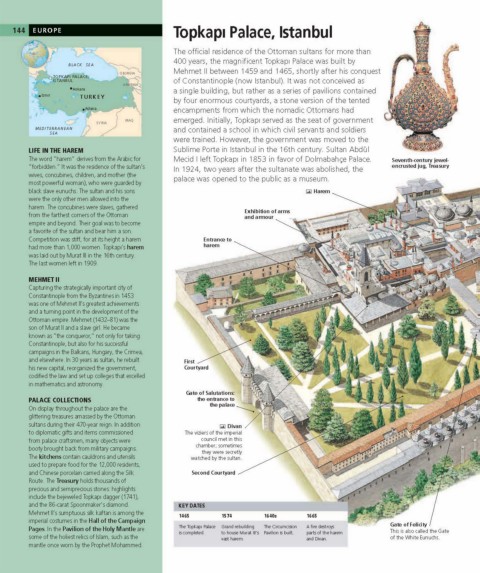
                                                     The official residence of the Ottoman sultans for more than
                                                     400 years, the magnificent T opkap1  Palace was built  by
                     BLACK  Sf A
                                                     Mehmet II  between 1459 and  1465, shortly after his conquest
                                     GEORGIA
               ttTOPKAPI  PALACE,
                 ISTANBUL                ""          of Constantinople (now  Istanbul).  It w as not conceived  as
                                     A~_;
                                                     a single building, but rather as  a series of  pavilions contained
            .1zm1r
                                                     by four enormous courtyards, a stone version of the tented
                         •Adana
                                                     encampments from w hich the nomadic Ottomans had
                                                     emerged. Initially,  Topkap1  served as the seat of government
           M!f)ITERRANfAN                            and contained a school in which civil servants and soldiers
                Sf  A
                                                     were trained. However, the government was moved to the
         Ll FE IN THE HAREM                          Sublime Porte in  Istanbul in the 16th century. Sultan Abdu I
         The word "harem" derives from the /liab1cfor   Mecid  I left T opkap1  in  1853 in favor of  Do lmabah ~e Palace.   Seventh-century jewel-
          "forbidden." It was the residence of the sultan's                                                           encrusted jug, Treasury
                                                     In  1924, two years after the sultanate w as abolished, the
         wives, concubines, children, and mother (the
                                                     palace was opened to the public as  a museum.
         most powerful woman), who were guarded by
         black s lave eunuchs. The sultan and his sons
         were the only other men allowed into the
         harem. The concubines were slaves, gathered
                                                                          Exhibition of arms
         from the farthest corners of the Ottoman
                                                                          and armour
         emp1re and beyond. Their goal was to become
         a favorite of the sultan and bear him a son
         Compeution was stiff, for at its het!tlt a harem     Entrance to
         had more than 1,000 women. Topkap1's harem           harem
         was laid out by Murat Ill  in the  16th century.
         The last women left in  1909.


         MEHMETII
         Capturing the strategically important dty of
         Constantinople from the Byzantines in  1453
         was one of Mehmet ll's greatest aclievements
         and a turn1ng point in the development of the
         Ottoman empirt>  Mehmt>t (1432-81)was the
         son of Murat II and a slave girl. Ht> bt>came
         kno'M'l as "the conqueror," not only for taking
         Constantinople, but also for his successful
         campaigns in the Balkans,  Hungary, the Crimea,
         and elsewhere. In 30 years as sultan, he rebui I t
         his new capital, reorganized the government    Courtyard
         codified the law and set up colleges that excelled
         in mathematics and astronomy.
                                                        Gate of Salutations:
         PALACE  COLLECTIONS                                the entrance to
                                                               the palace --.
         On dispi<PJ throughout the palact> are tht>
         glrttenng trt>aslJ't>S amassed by the Ottoman
         stJtans dunng their 470-year reign. In addttJon          !Ail  Divan
         to diplomatic gifts and items commissioned     The viziers of the imperial
         from palace craftsmen, many objects were            council met in this
                                                           chamber; sometimes
         booty brought back from military campaigns.
                                                             they were secretly
         The kitchens contain cauldrons and utensils      watched by the sultan.
         used to prepare food for the  12,000 residents,
         and Chinese porcelain carried along the Silk     Second Courtyard
          Route  The Treasury holds thousands of
         precious and semiprecious stones: highlights
         indude the bejeweled Topkap1 dagger (1741),
         and tht> 86-carat Spoonmake(  s  d1amond     KEY DATES
         Mehmet ll's Stmptuous silk kaftan is among the
                                                      1465         1574         1640s       1665
         impenal costumes in the Hall of the Campaign
                                                      The Topkap1 Palace   Grand rebuilding   The Circumci9on   A fire destroys   Gate of  Felicity
         Pages. In the Pavilion of the Holy Mantle are
                                                      is completed.   to houS(' Murat Ill's  Pavilion is built.   parts of the harem   This is also called the Gate
         some of the holiest relics of Islam, such as the          vast harem.              and Divan.               of the White Eunuchs.
         mantle once worn by the Prophet Mohammed.

