


Page 160 - DK Eyewitness Travel Guides - The World's Must-See Places
P. 160
AFRICA                                    Leptis Magna


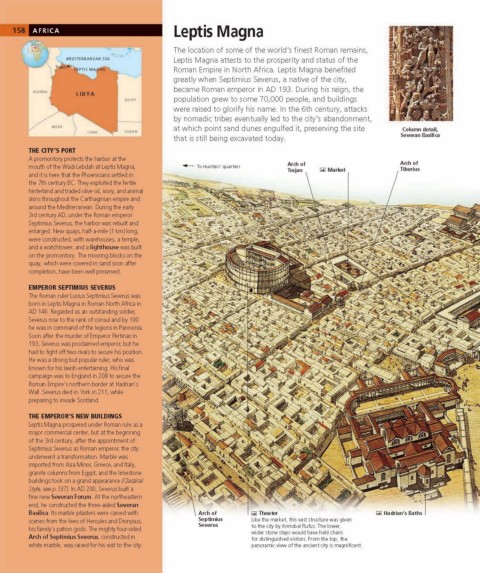
                                                     The location of some of the world's finest Roman  remains,
                     Mf{J/T£RRAN£AN SfA              Leptis Magna attests to the prosperity and status of the
                 ~I;•   EPTIS  MAGNA                 Roman Empire in  North Africa. Leptis Mag na benefited
                                                     greatly when Septimius Severus, a native of the city,
                                                     became R oman emperor in  AD  193. During his reign,  the
                                                     population grew  to some 70,000 people, and buildings
                                                     w ere raised to glorify his name. In the 6th century, attacks
                                                     by nomadic tribes eventually led  to the city's abandonment,
                                                     at which point sand dunes engulfed it, preserving the site          Column detail,
                                                                                                                        Sever  an Basilica
                                                     that is still being excavated today.
         THE OTY'S PORT
         A  promontory protects the harbor at the                                                                       Arch of
         mouth of the Wadi Lebdah at Leptis Magna,     ....._  T o Hunters' quarters   Arch of
                                                                                       Trajan   !;il Market             Tiberius
         and it is here that the Phoenicians settled in
         the 7th century BC.  They exploited the fertile
         hinterland and traded olive oil, ivory, and animal
         skins throughout the Carthaginian empire and
         around the Mediterranean. During the early
         3rd century AD, under the Roman emperor
         SeptJm1us Severus, the harbor was rebu11t and
         enl<rged  New quays, half-a-mile (11::m) long,
         were constructed, with warehouses, a temple,
         and a watchtower, and a lighthouse was bu1lt
         on the promontory. The mooring blocks on the
         quay, wh1ch were covered in sand soon after
         completion, have been well preserved.

         EMPEROR SEPTIMIUS SEVERUS
          The Roman ruler Lucius Septimius Severus was
         born 1n Leptis Magna in Roman North Afnca 1n
         AD 146  Regarded as an outstanding sold1er,
         Severus rose to the rank of consul and by 190
         he was 1n command of the legions in Pannon1a
         Soon after the murder of Emperor Pertinax 1n
          193, Severus was proclaimed emperor, but he
         had to fight off two rivals to secure his pos1t1on.
          He was a strong but popular ruler, who was
         known for his lavish entertaining. His final
         campaign was to England in 208 to secure the
          Roman Empire's northern border at Hadrian's
         Wall  Severus died in York in 211, while
         prepanng to invade Scotland.

         THE EMPEROR'S NEW BUILDINGS
         Leptls Magna prospered under Roman rule as a
         maJOr commerdal center, but at the beginn1ng
         of the 3rd century, after the appointment of
         Septi mius Severus as Roman emperor, the city
         undervvent a transformation. Marble was
         imported from Asia Minor, Greece, and Italy,
         gran1te columns from Egypt, and the limestone
         bu1ld1ngs took on a grand appearance (Oas~;ica/
         Style, seep. 137)  In AD 200, Severus bu1tt a
         f1ne new Severan F orum. At the northeastern
         end, he constructed the three-aisled Severan
         B asilica  Its marble pilasters were carved with   Arch of         ~ Thea ter                           ~  Ha drian's Baths
         scenes from the lives of Hercules and Dionysus,    Septimius       like the market, this vast structure was given
                                                            Sever  us       to the city by Annobal Rufus. The lower,
         h1s  family's patron gods. The mighty four-s1ded
                                                                            wider stone steps would have held chairs
         Arch of Septimius Severus, constructed 1n                          for distinguished visitors. From the top, the
         white marble, was raised for his visit to the city.                panoramic view of  the ancien t city is magnificent

