


Page 163 - DK Eyewitness Travel Guides - The World's Must-See Places
P. 163
MEDIT£111/ANEAN SEA
Al>xond r;a e
THE EAT PYRAMID, Catro
GIZA
EGYPT
UBYA Luxore RED
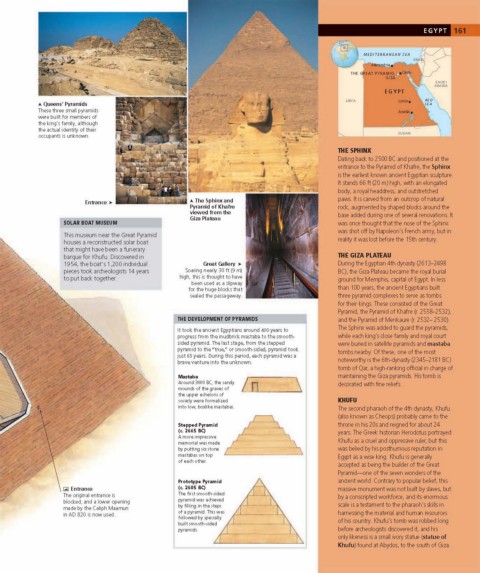
A Queens' Pyramids SEA
These three small pyramids A swkl e
were built for members of
lhe l<ing's fanily, although
lhe actual identity of their
occupants is unkno.Ml. SUOAN
lHE SPHINX
...
·, .... { Dating back to 2 500 B C and positioned at the
' entrance to the Pyramid of K hafre, the Sphinx
is the earliest known ancient Egyptian sculpture.
It stands 66 ft (2 0 m) high, with an elongated
body, a royal headdress, and outstretched
Entrance >- _..._...,llllj._ A The Sphinx and paws. It is carved from an outcrop of natural
Pyramid of Khafre rock, augmented by shaped blocks around the
viewed from the base added during one of several renovations. It
Giza Plateau
SOLAR BOAT MUSEUM was once thought that the nose of the Splinx
was shot off by Napoleon's French army, but in
Th1s museum near the Great Pyramid
houses a reconstructed solar boat reality it was lost before the 15th century
that might have been a funerary
barque for Khufu. Discovered in lHE GIZA PLATEAU
1954, the boat's 1,200 individual Great Gallery >- During the Egyptian 4th dynasty (2613-2498
pieces took archeologists 1 4 years Soaring nearly 30 ft (9 m) BC), the Giza Plateau became the royal burial
to put back together. high, this is thought to have ground for Memphis, capital of Egypt. In I ess
been used as a slipway
for the huge blocks that than 100 years, the ancient Egyptians built
sealed the passageway. three pyramid complexes to serve as tombs
for their kings. T hese conSisted of the Great
Pyramid, the Pyram1d of Khafre (r 2558-2532),
THE DEVELOPMENT OF PYRAMIDS and the Pyramid of Menkaure (r 2532-2530)
It took the ancient Egyptians around 400 years to The Sphinx was added to guard the pyramids,
progress from the mudbrick mastaba to the smooth- while each king's close fam1ty and royal court
sided pyramid. The last stage, from the stepped were buried in satellite pyramids and mastaba
pyramid to the "true,'' or smooth-sided, pyramid took tombs nearby. Of these, one of the most
just 65 years. During this period, each pyramid was a
brave venture into the unknown. noteworthy is the 6th-dynasty (2345-2181 BC)
tomb of Qar, a high-ranking official in charge of
Mastaba maintaining the Giza pyramids. His tomb is
Around 3000 BC, the sandy I [1 \ decorated with fine reliefs.
mounds of the graves of .. -~------ ~
the upper e<helons of
society were for mall zed KHUFU
into low, boxlike mastabas. The second pharaoh of the 4th dynasty, Ktufu
(also known as Cheops) probably came to the
St• pp• d Pyr am i d throne in his 20s and re1gned for about 24
(c. 2665 BC) years. The Greek historian Herodotus portrayed
A more impressive
memorial was made Khufu as a cruel and oppressi ve ruler, but this
by putting six stone \ was belied by his posthumous reputation in
mastabas on top Egypt as a wise king. Khufu is generally
of each other.
accepted as being the builder of the Great
Pyramid-one of the seven wonders of the
Prototyp• Pyramid andent world. Contrary to popular belief, this
~ Entrance (c. 2605 BC) massive monument was not built by slaves, but
The original entrance is The first smooth-sided by a conscripted workforce, and Its enormous
blocked, and a lcmer opening pyramid was a<hleved scale is a testament to the pharaoh's skills in
made by the Caliph Maannun by filling in the steps
in AD 820 is ncm used. of a pyramid. Ths was harnessing the matenal and human resources
followed by specially
bull t smooth-sided of his country. Khufu's tomb was robbed long
pyramids. before archeologists discovered 1 t, and his
only likeness is a small ivory statue (statue of
K hufu) found at Abydos, to the south of Giza.

