


Page 196 - DK Eyewitness Travel Guides - The World's Must-See Places
P. 196
194  ASIA                                      Temple of Heaven, Beijing


                                                     Built during the Ming dynasty, Tiantan, commonly called
                                                     the Temple of Heaven,  is one of the largest temple
                                                     complexes  in China and a model of Chinese architectural
                                                     balance and symbolism.  It was here that the emperor,
                                                     after a ceremonial procession  from the Forbidden City,
                                                     would make sacrifices and pray to heaven at the winter
                                                     solstice. As  the Son of Heaven,  the emperor could
                                                     intercede with the gods on behalf of his people and
                                                     ensure a good harvest. Off-limits to the common people
                                                     during the Ming and Qing dynasties, the Temple of
                                                     Heaven  is  situated  in a large park that now attracts          Gate to the Round Altar
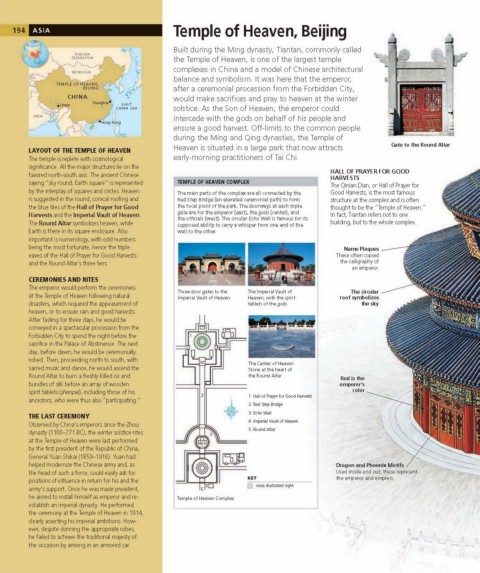
         LAYOUT OF THE TEMPLE OF HEAVEN
          The temple is replete with cosmological    early-morning practitioners of Tai  Chi.
         significance. JIJI the major structures lie on the
                                                                                                   HAll OF PRAYER FOR GOOD
         favored north-south axis. The ancient Chinese
                                                                                                   HARVESTS
         saying "sky round, Earth square" is represented   TEMPLE OF HEAVEN  COMPLEX               The Qinian Dian, or Hall of Prayer for
         by the interplay of squares and circles. Heaven   The main parts of the <Omplex are all connected by the   Good Harvests, is the most famous
         is suggested in the round, conical roofing and   Red Step Bridge (an elevated ceremonial path) to form   structure at the complex and is often
         the blue tiles of the Hall of Prayer for Good   the focal  point of the park. The doorways at each triple   thought to be the "Temple of Heaven."
                                                      gate are for the emperor (east), the gods (center), and
         Harvests and the Imperial Vault of Heaven.                                                In fact, Tiantan refers not to one
                                                      the officials (west). The circular Echo Wall is famous  for its
         The Round Altar symbolizes heaven, while     supposed ability to carry a whisper from one end of the   building, but to the whole complex.
         Earth is there in its square enclosure. Also   wall to the other.
         important is numerology, with odd numbers
         being the most fortunate, hence the triple                                                    Name Plaques
         eaves of the Hall of Prayer for Good Harvests   ~;-  -·   {H~                               These often copied
         and the Round Altar's three tiers.                                                           the calligraphy of
                                                                ..  JIIIJ- ·~-                            an emperor .
                                                                   . ...  .
                                                       '
         CEREMONIES AND RITES
          The emperor would perform the ceremonies
                                                      Three door gates to the   The Imperial Vault of    The drcular
         at the Temple of Heaven following natural    Imperial Vault of Heaven   Heaven, with the spirit   roof symbolizes
         disasters, which required the appeasement of                      tablets of the gods               the sky
         heaven, or to ensure rain and good harvests.
         After fasting for three days, he would be
         conveyed in a spectacular procession from the
         Forbidden City to spend the night before the
         sacrifice in the Palace of Abstinence.  The next
         day, before dawn, he would be ceremonially
         robed. Then, proceeding north to south, with
         sacred music and dance, he would ascend the                       Stone at the heart of
         Round Altar to burn a freshly killed ox and                       the Round Altar
                                                                                                      Red is the
         bundles of silk before an array of wooden                                                    emperor's
         spirit tablets (shenpai), including those of his                                                 <Oior
                                                             2             1  Hall of Prayer for Good HaiVests
         ancestors, who were thus also "participating."
                                                                           2  Red Step Bridge
                                                                           3  Ech:> Wall
         THE LAST CEREMONY
                                                                           4  Imperial Vault of Heaven
         Observed by China's emperors since the Zhou
                                                                           5  Round Altar
         dynasty (1100-771  BC), the winter solstice rites
         at the Temple of Heaven were last performed
         by the first president of the Republic of China,
         General Yuan Shikai (1859-1916)  Yuan had
         helped modernize the Chinese army and, as                                                   Dragon and Phoenix Motifs
         the head of such a force, could easily ask for                                              Used inside and out, these represent
                                                                                                     the emperor and empress.
         positions of influence in return for his and the
         army's support. Once he was made president,
         he aimed to install himself as emperor andre-  Temple of Heaven Complex
         establish an imperial dynasty.  He performed
         the ceremony at the Temple of Heaven in 1914,
         clearly asserting his imperial ambitions. How-
         ever, despite donning the appropriate robes,
         he failed to a chi eve the traditional majesty of
         the occasion by arriving in an armored car.

