


Page 199 - DK Eyewitness Travel Guides - The World's Must-See Places
P. 199
197
'"'~ ~···
~ FEDERATION
~TH
T (EASTSEA) JAPAN
KO REA SEA OF JAPAN
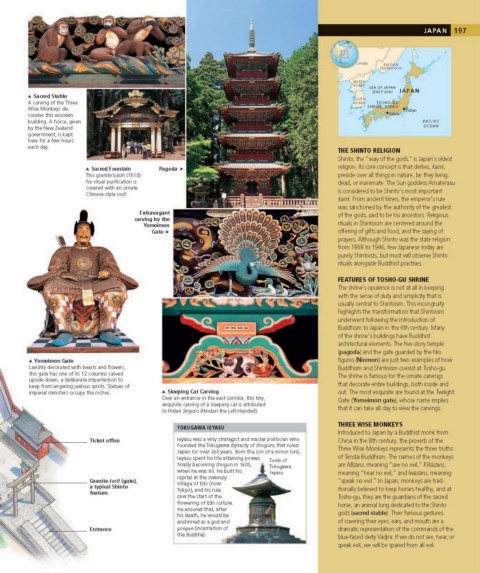
A Sacred S1able :;ourH
A carving of the Three l<o REA TO S HO-G U
Wise Monkeys d~ SHRINE, NIKKO O•t
cor ates this wooden •osaka okyo
building. A horse, given PAC/ FIC
by the New Zealand OC£AII/
government, is kept
here for a few hours
each day.
lHE SHINTO RELIGION
Shinto, the "way of the gods," is Japan's oldest
A Sacred Fountain religion. Its core concept is that deities, kami,
This granite basin (1618) preside over all things in nature, be they living,
for ritual purification is dead, or inanimate. The Sun goddess Amaterasu
covered with an ornate
Chinese-style roof. is considered to be Shinto's most important
kami. From ancient times, the emperor's rule
was sanctioned by the authority of the greatest
Extravagant of the gods, said to be his ancestors. Religious
carving by the
Yomeimon rituals in Shintoism are centered around the
Gate> offering of gifts and food, and the saying of
prayers. Although Shinto was the state rei igion
from 1868 to 1946, few Japanese today are
purely Shintoists, but most will observe Shinto
rituals alongside Buddhist practises.
FEATURES OF TOSHO-GU SHRINE
The shrine's opulence is not at all in keeping
with the sense of duty and simplicity that is
usually central to Shintoism. This incongruity
highlights the transformation that Shintoism
underwent following the introduction of
Buddhism to Japan in the 6th century. Many
of the shrine's buildings have Buddhist
architectural elements. The five-story temple
(pagoda) and the gate guarded by the Ni o
A Yomeimon Gate figures (Niomon) are just two examples of how
Lavishly decorated with beasts and flowers, Buddhism and Shintoism coexist at Tosho-gu.
this gate has one of its 12 columns carved The shrine is famous for the ornate carvings
upside down, a deliberate imperfection to
keep from angering jealous spirits. Statues of that decorate entire buildings, both inside and
imperial ministers occupy the niches. A Sleeping Cat Carving out. The most ex qui site are found at the Twilight
Over an entrance in the east corridor, this tiny, Gate (Yomeimon gate), whose name implies
exquisite carving of a sleeping cat is attributed
to Hidari Jingoro (Hindari the Left-Handed) that it can take all day to view the carvings.
lHREE WISE MONKEYS
TOKUGAWA IEYASU
Introduced to Japan by a Buddhist monk from
leyasu was a wily strategist and master politician who China in the 8th century, the proverb of the
founded the Tokugawa dynasty of shoguns that ruled
Japan for over 260 years. Born the son of a minor lord, Three Wise Monkeys represents the three truths
leyasu spent his life attaining power, Tomb of of Tendai Buddhism. The names of the monkeys
finally becoming shogun in 1603, ii Tokugawa are Mizaru, meaning "see no evil," Kikazaru,
when he was 60. He built his • leyasu meaning "hear no evil," and lvvazaru, meaning
capital at the swampy
~·;:...------- Granite torii (gate), village of Edo (now "speak no evi I." In Japan, monkeys are trad-
a typical Shinto Tokyo), and his rule itionally believed to keep horses healthy, and at
feature
saw the start of the Tosho-gu, they are the guardians of the sacred
flowering of Edo culture. horse, an animal long dedicated to the Shinto
He ensured that, after
his death, he would be gods (sacred stable) Their famous gestures
enshrined as a god and of covering their eyes, ears, and mouth are a
gong en (incarnation of dramatic representation of the commands of the
the Buddha).
blue-faced deity VadJra if we do not see, hear, or
speak evil, we will be spared from all evil.

