


Page 200 - DK Eyewitness Travel Guides - The World's Must-See Places
P. 200
198  ASIA                                      Todai-ji Temple, Nara

         ~
        ~ CHINA  -~~SIAN                             There are many reasons to visit the impressive Todai-ji  Temple
                                                     in  Nara, but its sheer size must be the main attraction. The

                 :J =~~~AT ION                       temple is  only two-thirds of its original size, due to fires and
            ~                                        alterations over the centuries, yet it is still the largest wooden
              KO Rf.A   SEA  OF JAPAN                building in  the world. An enormous and costly project, Todai-
              ~ (EASTSEA)
              ~
              SOUTH       JAPAN                      ji was ordered by Emperor Shomyo in the mid-8th century
              K OREA
                             • Tokyo                 to highlight the position of Nara as a powerful Buddhist site
             TODAI-)1  TEMPLE,  0
                •   'NARA
                                                     and Japan's capital.  Inside is a magnificent 53-ft (16-m) high
                                  PACIFIC
                                   OCEAr.t           seated  bronze statue of the Buddha-the largest in Japan.
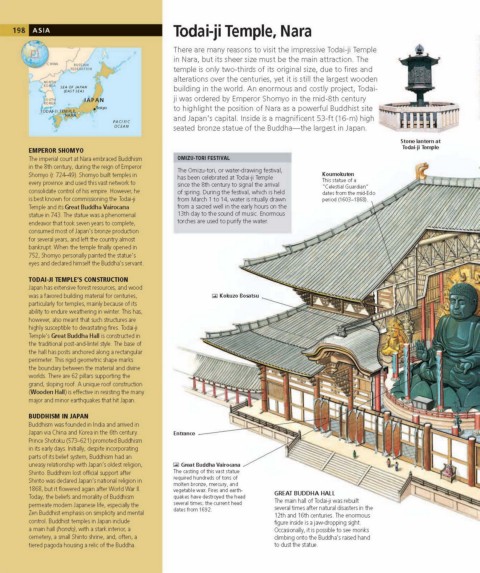
                                                                                                                        Stone lantern at
                                                                                                                         Todai-ji Temple
         EMPEROR SHOMYO
          The imperial court at Nara embraced Buddhism   OMIZU-TORI FESTIVAL
         in the 8th century, during the reign of Emperor
                                                      The Omizu-tori, or water-drawing festival,
         Shomyo (r  724-49)  Shomyo built temples in                                             Koumolcuten
                                                      has been celebrated at Todai-ji Temple
         every pro vi nee and used this vast network to   si nee the 8th century to signa I the a rriva I   This statue of a
                                                                                                 "Celestial Guardian"
         consolidate control of his empire .. However, he   of spring. During the festiva I, which is held   dates from the mid-Edo
         is best known for commissioning the  Todai-ji   from March 1 to 14, water is ritually drawn   period (1603-1868)
         Temple and its Great Buddha Vairocana        from a sacred well in the early hours on the
         statue in 743. The statue was a phenomenal   13th day to the sound of music. Enormous
         endeavor that took seven years to complete,   torches are used to purify the water.
         consumed most of Japan's bronze production
         for several years, and left the country almost
         bankrupt When the temple finally opened in
         752, Shomyo personally painted the statue's
         eyes and declared himself the Buddha's servant


         TODAI-JI TEMPLE'S CONSTRUCTION
         Japan has extensive forest resources, and wood
         was a favored building material for centuries,         l;;i;J  Kolcuzo Bosatsu
         particularly for tempi es, mainly because of its
         ability to endure weathering in winter. This has,
         however, also meant that such structures are
         highly susceptible to devastating fires. Todai-ji
         Temple's Great Buddha Hall is constructed in
         the traditional post -and-lintel style. The base of
         the hall has posts anchored along a rectangular
         perimeter. This rigid geometric shape marks
         the boundary between the material and divine
         worlds. There are 62 pillars supporting the
         grand, sloping roof. A unique roof construction
         (Wooden Hall) is effective in resisting the many
         major and minor earthquakes that hit Japan.

         BUDDHISM  IN JAPAN
         Buddhism was founded in India and arrived in
         Japan via China and  Korea in the 6th century.
         Prince Shotoku (573-621) promoted Buddhism
         in its early days. Initially, despite incorporating
         parts of its belief system, Buddhism had an
         uneasy relationship with Japan's oldest religion,   l;;i;J  Great Buddha Vairo<ana
         Shinto. Buddhism lost official support after   The casting of this vast statue
                                                     required hundreds of tons of
         Shinto was declared Japan's national religion in
                                                     molten bronze, mercUiy, and
          1868, but it flowered again after World War II   vegetable wax. Fires and earth-
         Today, the beliefs and morality of Buddhism   quakes have destroyed the head   GREAT BUDDHA HAll
                                                     several times; the current head   The main hall of Todai-ji was rebuilt
         permeate modern Japanese life, especially the                             several times after natural disasters in the
         Zen Buddhist emphasis on simplicity and mental   dates from 1692.
                                                                                   12th and 16th centuries. The enormous
         control Buddhist temples in Japan include                                 figure inside is a jaw-dropping sight
         a main hall (hondo), with a stark interior, a                             Occasionally, it is possible to see monks
         cemetery, a small Shinto shrine, and, often, a                            climbing onto the Buddha's raised hand
         tiered pagoda housing a relic of the Buddha.                              to dust the statue.

