


Page 207 - DK Eyewitness Travel Guides - The World's Must-See Places
P. 207
205
CHINA
INDIA
Mumtei•
ARAB/Af>l
SEA .Chennai
lf>IOIAf>l
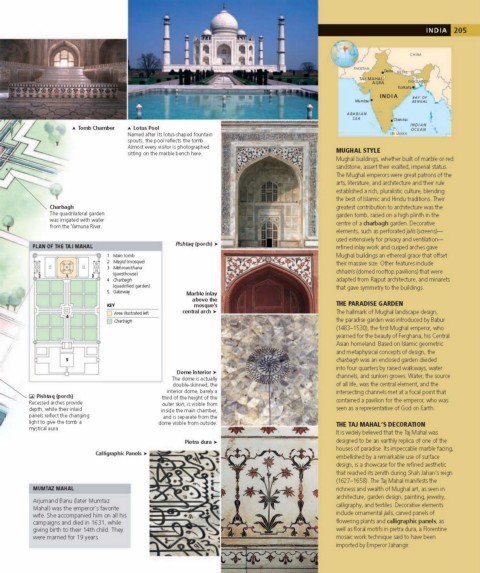
A Tomb Chamber A lotus Pool OCEAf>l
Named after its lotus-shaped fountain S~IIANKA
spouts, the pool reflects the tomb.
Almost every visitor is photographed
sitting on the marble bench here. MUGHAL STYLE
Mughal buildings, whether built of marble or red
sandstone, assert their exalted, imperial status.
lhe Mughal emperors were great patrons of the
arts, I iterature, and architecture and their rule
established a rich, pluralistic culture, blending
y
the best of Islamic and Hindu traditions. Their
Charbagh greatest contribution to architecture was the
The quadrilateral garden garden tomb, raised on a high pi inth in the
was irrigated with water
from the Yamuna River. centre of a charbagh garden. Decorative
elements, such as perforated jalis (screens)--
used extensively for privacy and ventilation---
PLAN OF THE TAJ MAHAL refined inlay work and cusped arches gave
1 Main tomb Mughal buildings an ethereal grace that offset
2 Masjid (mosque)
their massive size. Other features include
3 M2hmankhana
(guesthouse) dJha tris (domed rooftop pavilions) that were
4 !J?arbagh adapted from Raj put architecture, and minarets
(quadrified garden) that gave symm etl}l to the buildings.
5 G<A.eWaj Marble inlay
above the
KEY mosque's lHE PARADISE GARDEN
central arch >
D Area illustrated left lhe hallmark of Mughallandscape design,
D Charbagh the paradise garden was introduced by Babur
(1483-1530), the first Mughal emperor, who
yearned for the beauty of Ferghana, his Central
Asian homeland. Based on Islamic geometric
and metaphysical concepts of design, the
dJarbagh was an enclosed garden divided
into four quarters by raised walkways, water
Dome Interior >
The dome is actually channels, and sunken groves. Water, the source
double-skinned; the of all life, was the central element, and the
interior dome, barely a intersecting channels met at a focal point that
~ ~ Pish1aq (porch) third of the height of the
Recessed arches provide outer skin, is visible from contained a pavilion for the emperor, who was
depth, while their inlaid inside the main chamber, seen as a representative of God on Earth.
panels reflect the changing and is separate from the
light to give the tomb a dome visible from outside. lHE TAJ MAHAL'S DECORA110N
mystical aura.
It is widely believed that the Taj M a hal was
Pietra dura > designed to be an earthly replica of one of the
houses of paradise. Its impeccable marble facing,
em belli shed by a remarkable use of surface
design, is a showcase for the refined aesthetic
that reached its zenith during Shah Jahan's reign
(1627-1658) The Taj Mahal manifests the
MUMTAZ MAHAL richness and wealth of Mughal art, as seen in
architecture, garden design, painting, jewell}/,
Arjumand Banu (later Mumtaz
Mahal) was the emperor's favorite calligraphy, and textiles. Decorative elements
wife. She accompanied him on all his include ornamental ja/is, carved panels of
campaigns and died in 1631, while flowering plants and calligraphic panels, as
giving birth to their 14th chi I d. They well as floral motifs in pietra dura, a Florentine
were married for 19 years. mosaic work technique said to have been
imported by Emperor Jahangir.

