


Page 208 - DK Eyewitness Travel Guides - The World's Must-See Places
P. 208
206  ASIA                                       Fatehpur Sikri

                                                     Built by Emperor Akbar between 1571  and  1585 in  honor
                               CHINA
                                                     of Salim Chishti, a famous Sufi saint of the Chishti order,
                                                     Fatehpur Sikri was the capital of the Mughal empire for 14
                      . oelh'
                FATEHPURO                            years.  One of the best examples of a Mug hal walled city, with
               .-.!  SIKRI
                                                     defined areas and imposing gateways, its architecture is a
                      INDIA    BAY OF                blend of Hindu and Islamic styles  (Mugha/ Style, see p.204),
                               BENGAL
                                                     and reflects Akbar's secular vision as well as  his type of
            ARABIA~
             SEA         eChennai                    governance. The city was abandoned, some say for lack of
                               fWD/A~                water, in  1585, and many of its treasures were plundered.  It
                         I.    OCEA~                                                                                      Fretwork.ja/i
                         SpllANI(A
                                                     owes its present state of preservation  to the efforts of Lord
                                                     Curzon, Viceroy of India and a great conservationist.
         THE JAM I MASJID AND SALIM CHISHTI
         Towering over Fatehpur Sikri is the grand open
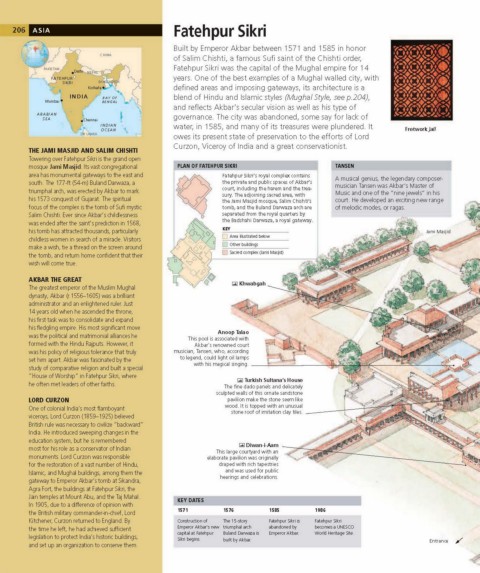
         mosque Jami Masjid.ltsvast congregational    PLAN OF FATEHPUR SIKRI                         TANSEN
         area has monumental gateways to the east and              Fatehpur Sikri's royal complex contains   A musical  genius,  the legendary composer-
         south. The  177-ft (54-m) Buland Darwaza, a               the private and public spaces of Akbar's   musician  Tansen was Akbar's Master of
         triumphal arch, was erected by Akbar to mark              court, including the harem and the trea-
                                                                   sury. The adjoining sacred area, with   Music and one of the "nine jewels" in his
         his 1 5 73 conquest of Gujarat The spiritual              the Jami Masjid mosque, Salim Chishti's   court. He developed an exciting new range
         focus of the complex is the tomb of Sufi mystic           tomb, and the Buland Darwaza arch are   of melodic modes, or ragas.
         Salim Chishti. Ever since Akbar's childlessness           separated from  the royal quarters by
                                                                   the Badshahi Darwaza, a royal  gateway.
         was ended after the saint's prediction in 1 568,
         his tomb has attracted thousands, particularly            KEY                                                          Jami Masjid
                                                                   0  Area illustrated bebw
         childless women in search of a miracle, Visitors
                                                                   0  Other buildings
         make a wish, tie a thread on the screen around
                                                                   D Sacred complex (Jami Masjid)
         the tomb, and return home confident that their
         wish will come true.
         AKBAR THE GREAT
                                                                      ~ Khwabgah
         The greatest emperor of the Muslim Mughal
         dynasty, Akbar (r 1556-1605) was a brilliant
         administrator and an enlightened ruler. Just
          14 years old when he ascended the throne,
         his first task was to consolidate and expand
         his fledgling empire. His most significant move
                                                                  Anoop Talao
         was the political and matrimonial alliances he
                                                         This pool is associated witll
         formed with the Hindu Rajputs.  However, it       Akbar's renowned court
         was his policy of religious tolerance that truly   musician, Tansen, who, according
                                                       to legend, could light oil lamps
         set him apart Akbar was fascinated by the
                                                           with his magical singing.  ---=---~-----=--~c......+-~iW!If''--7~-----'==----~~
         study of comparative rei igion and built a special
          "House of Worship" in F atehpur Sikri, where
                                                                        ~ Turkish Sultana's House
         he often met leaders of other faiths.                      The fine dado panels and delicately
                                                                 sculpted walls of this ornate sandstone
         LORD CURZON                                                 pavilion make the stone seem like -----~=~~;;;~~~~~~~~~~~
                                                                    wood. It is topped with an unusual
         One of colonial India's most flamboyant
                                                                      stone roof of imitation clay tiles.
         viceroys, Lord Curzon ( 1859-1925) believed
         British rule was necessary to civilize "backward"
         India. He introduced sweeping changes in the
         education system, but he is remembered
                                                                        ~ Diwan-i-Aam
         most for his role as a conservator of Indian
                                                                 This large courtyard with an
         monuments. Lord Curzon was responsible                elaborate pavilion was originally
         for the restoration of a vast number of Hindu,           draped with rich tapestries
                                                                    and was used for pub I ic
         Islamic, and Mughal buildings, among them the
                                                                  hearings and  eel ebr ations.
         gateway to Emperor Akbar's tomb at Sikandra,
         Agra Fort, the buildings at F atehpur Sikri, the
         Jain tem pies at Mount Abu, and the Taj Mahal.
                                                      KEY DATES
         In 1905, due to a difference of opinion with
         the British military commander-in-chief, Lord   1571       1576         1585          1986
         Kitchener, Curzon returned to England. By    Construct on of   The 1 5-stol)'   Fatehpur Sikri is   Fatehpur Sikri
         the time he left, he had achieved sufficient   Emperor Akbar's new  triumphal arch   abandoned by   becomes a UNESCO
                                                      cap~al at Fatehpu r   Buland DaiWaza is   Emperor Akbar.   World Heritage Site.
         legislation to protect India's historic buildings,
                                                      Sikri begins.   built by Akbar.                                            Entrance   /
         and set up an organization to conserve them.

