


Page 220 - DK Eyewitness Travel Guides - The World's Must-See Places
P. 220
Borobodur Temple, Java
     218  ASIA

                                                     The world's largest Buddhist stupa (Buddhist Style, see
                                                     p.209}, Borobodur Temple is made from 1.6 million blocks
                                                     of volcanic andesite and is constructed over nine levels.  F ive
                                    PACIFIC
                                    OCEAII           square terraces are surmounted by three circular ones and
                                                     another stupa at the top. The structure's powerful image is
                        I NDONESIA
                   . Jakarta                         enhanced further by five levels of sublime carvings depicting
                    Q
             BOROBODUR                               the lives of the Buddha, expounding the meaning of his
            TEMPLE,  JAVA
                             .,r                     doctrine.  These images form the most comprehensive
            lti{)IAW  OCEAW                          ensemble of Buddhist reliefs ever carved.  As  pilgrims
                                 AUSTRALIA
                                                     circumambulate, praying before each image, they ascend
                                                     from the terrestrial to the divine world. Abandoned in  the
         THE BAS-RE LIEFS
                                                                                                                    A Temple Roof
         There  are 1  .460 superbly carved bas-relief!\.   1Oth century, and later buried  under ash from a volcanic
         extending  for 3 miles (5 krn), around the five   eruption, the temple was not found again  until 1815.
         I  ower I  e vels  of Borobodur. As visitors walk
         cl ockvvise, keeping the  monument to the right.
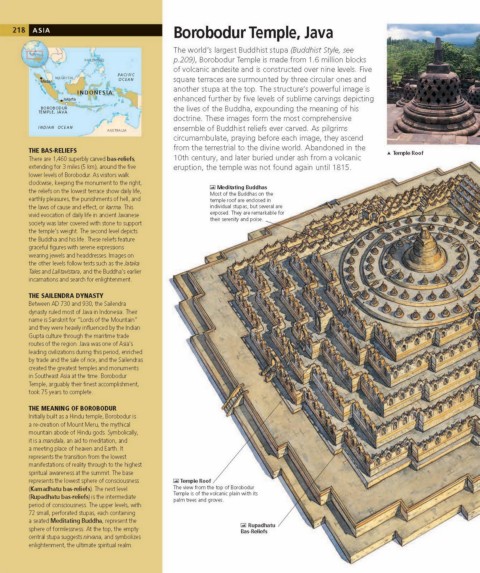
                                                               ~  Medi1ating Buddhas
         the rei iefs  on the lowest terrace s how daily I  ife,
                                                                Most of the Buddhas  on  the
         earthly pleasures, the punishments of hell, and        temple roof are enclosed in
         the laws of cause and effect, or !Grma. This           individual stupas, but several are
                                                                exposed. They are remarkable for
         vivid evocation of daily life  in ancient Javanese
                                                                their serenity and poise.
         society was later covered with stone to support
         the temple's weight  The second level depicts
         the Buddha and his life  These reliefs feature
         graceful figures wrth serene expressions
         wearing jewels and headdresses Images on
         the other levels follow texts such as the Jataka
          Tales and La5tavistara, and the Buddha's earl1er
         incarnations and search for enlightenment

         THE SAILENDRA DYNAS TY
         Between />D 730 and 930, the Sa1lendra
          dynasty ruled most of Java 1n lndones1a. Their
         name is Sanskrit for "Lords of the Mountain"
         and they were heavily influenced by the Indian
         Gupta culture through the maritime trade
         routes of the region. Java was one of Asia's
         leading civilizations during this period, enriched
         by trade and the  sale  of rice, and the S ailendras
         created the  greatest temples and monuments
         in Southeast Asia  at the time. Borobodur
          Temple, arguably their finest accomplis hment.
         took 75 years  to complete.


         THE  MEANING OF BOROBODUR
         Initially built as a Hindu temple, Borobodur is
         a re-creation of Mount Meru, the mythical
         mountan abode of H1nd.J gods  Symbolically,
         it  is a  mandala, an a1d to medtat1on, and
         a meeting place of he<PJen and Earth  It
         represents the transrtJon from the lowest
         manrfestabons of  realrty through to the nghest
          spiritual awareness at the sunm1t The base
         represents the lowest sphere of consaousness   ~ Temple  Roof
         (Kamadhatu bas-reliefs) The next level      The view from the top of BOfobodur
                                                     Temple is of the volcanic plain with its
         (Rupadhatu bas-reliefs) IS the mtermediate
                                                     palm trees and groves.
         period of consciousness. The upper levels, with
         72 small, perforated stupas, each containing
         a seated Meditating Buddha, represent the
                                                                         ~  Rupadhatu
         sphere of formlessness. At the top, the empty
                                                                         Bas-R eliefs
         central stupa s uggests nirvana, and symbolizes
         enlightenment. the  ultimate  spiritual realm.

