Page 219 - DK Eyewitness Travel Guides - The World's Must-See Places
P. 219
CAMBODIA  217


           KEY DATES
           1113-50      1432          1860          1898          1992          1993
           Construction of   The Siamese (Thais)   Angkor Wat is   The French kole   AngkorWat   An internatbnal
          Angkor ll'l.9t during   sack Angkor Wat   "rediscovered" by   Fran<;aise d 'Extreme   is declared a   conservation project
                                                                                                                 QANGKOR WAT
           the rule of the   and the s~e is   French naturalist   Olien tstarts to   UNESCO \1\t>rld   starts the preser-
           Khmer empire.   abandoned.   Henri Mouhot.   clear the site.   Her~age Site.   vation of Angkor
                                                                                Wat's temples.                  CAMBODIA
                                                                                                              Phnom  Penh•

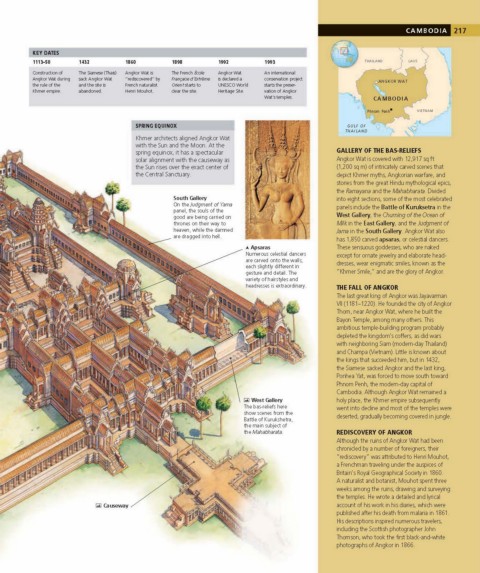
                                         SPRING EQUINOX                                                 GULF  OF
                                                                                                        THAILAf\/D
                                         Khmer architects aligned Angkor Wat
                                         with the Sun and the Moon. At the
                                         spring equinox, it has a spectacular                        GALLERY OF lHE BAS-RELIEFS
                                         solar alignment with the causeway as                        Angkor Wat is covered with  12,917 sq ft
                                         the Sun rises over the exact center of                      ( 1 ,2 00 sq m) of intricately carved scenes that
                                         the Central Sanctuary.                                      depict Khmer myths, Angkorian warfare, and
                                                                                                     stories from the great Hindu mythological epics,
                                                                                                     the Ramayana and the Mahabharata. Divided
                                                     South Gallery                                   into eight sections, some of the most celebrated
                                                     On  the Judgment of Yama                        panels include the Battle of Kuruksetra in the
                                                     panel, the sou Is of the
                                                     good are being carried on                       West Gallery, the Churning of the Ocean of
                                                     thrones on their way to                         Milk in the East Gallery, and the Judgment of
                                                     heaven, while the damned                        Jama in the South Gallery .. Angkor Wat also
                                                     are dragged into hell.
                                                                                                     has 1 ,8 50 carved apsaras, or celestial dancers.
                                                                          A Apsaras                  These sensuous goddesses, who are naked
                                                                          Numerous celestial  dancers   except for ornate jewelry and elaborate head-
                                                                          are carved  onto the walls,
                                                                          each slightly different in   dresses, wear enigmatic smiles, known as the
                                                                          gesture and detail. The    "Khmer Smile," and are the glory of Angkor.
                                                                          variety of hairstyles and
                                                                          headresses is extraordinary.   lHE FALL OF ANGKOR
                                                                                                     The last great king of Angkor was Jayavarman
                                                                                                     VII ( 1181-1220)  He founded the city of Angkor
                                                                                                     Thom, near Angkor Wat, where he built the
                                                                                                     Bayon Temple, among many others. This
                                                                                                     ambitious temple-building program probably
                                                                                                     depleted the kingdom's coffers, as did wars
                                                                                                     with neighboring Siam (modern-day Thailand)
                                                                                                     and Champa (Vietnam)  Little is known about
                                                                                                     the kings that succeeded him, but in 1432,
                                                                                                     the Siamese sacked Angkor and the last king,
                                                                                                     Ponhea Yat, was forced to move south toward
                                                                                                     Phnom Penh, the modern-day capital of
                                                                                                     Cambodia. Although Angkor Wat remained a
                                                                                                     holy place, the  Khmer empire subsequently
                                                                                                     went into decline and most of the tem pies were
                                                                          show scenes  from the
                                                                          Battle of Kurukshetra,     deserted, gradually becoming covered in jungle.
                                                                          the main subject of
                                                                          theMahabharata.            REDISCOVERY OF ANGKOR
                                                                                                     Although the ruins of Angkor Wat had been
                                                                                                     chronic! ed by a number of foreigners, their
                                                                                                     "rediscovery" was attributed to Henri M ouhot,
                                                                                                     a Frenchman traveling under the auspices of
                                                                                                     Britain's Royal Geographical Society in  1860.
                                                                                                     A natura list and botanist, Mouhot spent three
                                                                                                     weeks among the ruins, drawing and surveying
                                                                                                     the tempi es. He wrote a detailed and lyrical
                             ~ Causeway                                                              account of his work in his diaries, which were
                                                                                                     published after his death from malaria in 1861.
                                                                                                     His descriptions inspired numerous travelers,
                                                                                                     including the Scottish photographer John
                                                                                                     Thomson, who took the first black-and-white
                                                                                                     photographs of Angkor in 1866.
   214   215   216   217   218   219   220   221   222   223   224