


Page 252 - DK Eyewitness Travel Guides - The World's Must-See Places
P. 252
THE  AMERICAS                            Chaco Culture National Historical Park


                                                     One of the most impressive cultural sites  in the American
                                                     Southwest, Chaco Culture National Historical Park at Chaco
                                                     Canyon reflects  the sophistication of the Ancestral Puebloan
                                                     civilization (also  known as  the Anasazi)  that existed here. With
              CHACO  CULTURE    Now York•            its six  "great houses" (pueblos containing hundreds of rooms),
                NATIONAL
             HISTORICAL PARK   Washington, D.C. •
                                                     and many lesser sites,  the canyon was once the political,
                                                     religious, and cultural center for this people.  It is thought that
                                     ATLANTIC
                                      OCEAN
                                                     Chaco's population was small;  despite the size of the pueblos,
                            GULF OF
                            MEXICO                   the land could  not have supported a larger community.
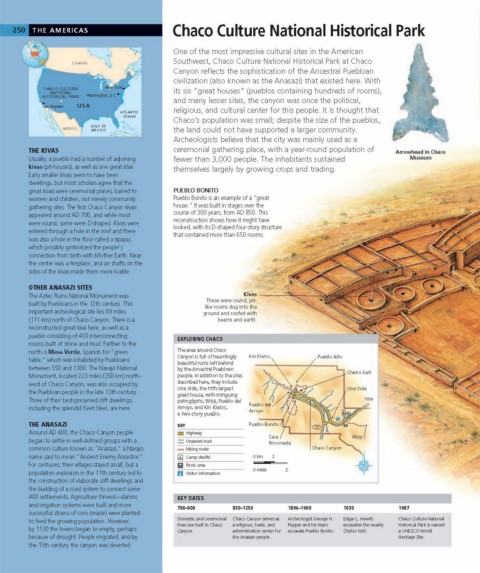
                                                     Archeologists believe that the city was mainly used as a
         THE KIVAS                                   ceremonial gathering place, with a year-round population of       Arrowhead in Chaco
         Usually, a pueblo had a number of adjoining   fewer than 3,000 people.  The inhabitants sustained                 Museum
         kivas (pit-houses), as well as one great kiva.   themselves  largely by growing crops and  trading.
         Early smaller kivas seem to have been
         dwellings, but most scholars agree that the
         great kivas were ceremonial places, barred to   PUEBLO BONITO
         women and children, not merely community    Pueblo Bonito is an example of a "great
         gathering sites. The first Chaco Canyon kJvas   house." It was built in stages over the
                                                     course of 300 years, from AD 850. This
         appeared around AD 700, and while most
                                                     reconstruction shows how it might have
         were round, some were D-shaped. Kivas were
                                                     looked, with its D-shaped four-story structure
         entered through a hoi e in the roof and there
                                                     that contained more than 650 rooms.
         was also a hole in the floor called a sipapu,
         which possibly symbolized the people's
         connection from birth with Mother Earth. Near
         the center was a fireplace, and air shafts on the
         sides of the kivas made them more livable.

         OTHER ANASAZI SITES
         The Aztec Ruins National Monument was                           Kivas  -  -,---"""-=,---  ---">.:l!
                                                              These were round, pit-
         built by Puebloans in the  12th century. This
                                                              like rooms dug in to the
         important archeological site I ies 69 miles         ground and roofed with
         ( 111  km) north of Chaco Canyon. There is a             beams and earth.
         reconstructed great kiva here, as well as a
         pueblo consisting of 4 50 interconnecting
                                                      EXPLORING CHACO
         rooms bui It of stone and mud. Farther to the
         north is Mesa Verde, Spanish for "green      The area around Chaco
                                                      Canyon is full of hauntingly
         table," which was inhabited by Puebloans
                                                      beautiful ruins I eft behind
         between 550 and 1300. The Navajo National    by the Ancestral Puebl oa n
         Monument, located 223 miles (358 km) north-  people. In addition to the sites
         west of Chaco Canyon, was also occupied by   described here, they include
                                                      Una Vida, the fifth-largest
         the Puebloan people in the late 13th century.
                                                      great house, with intriguing
         Three of their best-preserved diff dwellings,   petroglyphs, Wiji ji, Pueblo del
         including the splendid Keet Steel, are here.   AJ"royo, and Kin  Kletso,
                                                      a two-story pueblo.
         THEANASAZI                                   KEY                  Pueblo Bonito
         Around AD 400, the Chaco Canyon people       ::::l Highway
                                                                                 Cas a
         began to settle in well-defined groups with a   = Unpaved 10ad
         common culture known as "Anasazi," a Navajo   -  Hiking route
         name said to mean "Ancient Enemy Ancestor."   ~ Camp s~e/R\1       0 km   2
         For centuries, their villages stayed small, but a   fii1  Pi:nic area
                                                                            0 miles
         population explosion in the 11th century I ed to   0  Vis~or information
         the construction of elaborate cliff dwellings and
         the bui !ding of a road system to connect some
         400 settlements. Agriculture thrived-damns   KEY DATES
         and irrigation systems were built and more
                                                      700-900         850-1250         1896-1900       1920             1987
         successful strains of corn (maize) were planted
         to feed the growing population. However,     Domestic and ceremonial   Chaco canyon serves as   Archeologist George H.   Edgar L.  Hewitt   Chaco Culture Natbnal
                                                      kivas are bui~ in Chaco   a religious, trade, and   Pepper and his team   excavates the nearby   Historical Park is named
         by 1130 the towns began to empty, perhaps    canyon.         administration centerfor   excavate Pueblo Bonito.   Chetro Ketl.   a UNESCO World
         because of drought. People migrated, and by                  the Anasazi people.                               Her~age Site.
         the  13th century the canyon was deserted.

