


Page 48 - DK Eyewitness Travel Guides - The World's Must-See Places
P. 48
46  EUROPE                                     Het Loo Palace, Apeldoorn


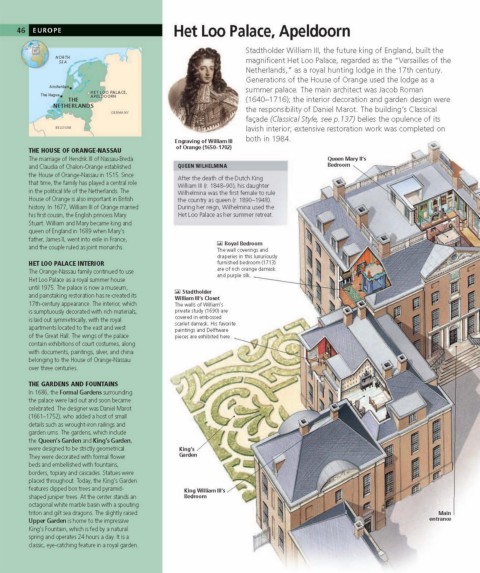
                                                                          Stadtholder William Ill,  the future king of England, built the
                 WORTH
                  SEA                                                     magnificent Het Loo Palace,  regarded as  the "Versailles of the
                                                                          Netherlands," as a royal  hunting lodge in the 17th century.
                                                                          Generations of the House of Orange used  the lodge as  a
                Amst9'rdam•
                           o HET L\)'0  PALACE,                           summer palace.  The main architect was Jacob Roman
             The Hague.     APEL<DOORN
                     THE                                                  ( 1640-1 716);  the interior decoration and garden design were
                 NETHERLANDS                                              the responsibility of Daniel Marot. The building's Classical
                                  GERMANY
                                                                          fa<;ade (Classical Style, seep. 137) belies the opulence of its
                 BELGIUM                                                  lavish  interior; extensive restoration work was completed on

                                                     Engraving of William Ill   both  in  1984.
                                                     of Orange (1650--1702)
         THE HOUSE OF ORANGE-NASSAU
         The marriage of Hendrik Ill of Nassau-Breda                                               Queen Mary ll's
         and Claudia of Chalon-Orange established     QUEEN WILHELMINA                             Bedroom
         the House of Orange-Nassau in 1515. Since
                                                      After the death of the Dutch King
         that time, the family has played a central role
                                                      William Ill  (r  1848-90), his daughter
         in the political life of the Netherlands.  The   Wilhelmina was the first female to rule
         House of Orange is also important in British   the country as queen (r 1890-1948)
         history. In 1677, William Ill of Orange married   During her reign, Wilhelmina used the
         his first cousin, the English princess Mary   Het Loo Palace as her summer retreat.
         Stuart. William and Mary became king and
         queen of England in 1689 when Mary's
         father, James II, went into exile in France,
                                                                  ~ Royal Bedroom
         and the couple ruled as joint monarchs.
                                                                  The wall coverings and
                                                                  draperies in this luxuriously
         HET LOO PALACE INTERIOR                                  furnished bedroom (1713)
          The Orange-Nassau family continued to use               are of rich orange damask
                                                                  and purple silk.
         H et Loo Pal ace as a royal sum mer house
         until1975. The palace is now a museum,
                                                     ~ Stadtholder
         and painstaking restoration has re-created its
                                                     William Ill's Closet
          17th-century appearance .. The interior, which   The walls of William's
         is sumptuously decorated with rich materials,   private study (1690) are
         is laid out symmetrically, with the royal   covered in embossed
                                                     scarlet damask. His favorite
         apartments located to the east and west     paintings and Delftware
         of the Great Hall. The wings of the palace   pieces are exhibited here.
         contain exhibitions of court costumes, along
         with documents, paintings, silver, and china
         belonging to the House of Orange-Nassau
         over three centuries.

         THE GARDENS AND FOUNTAINS
         In 1686, the Formal Gardens surrounding
         the palace were laid out and soon became
         eel ebr ate d. The designer was Daniel Marot
         (  1661-17 52), who added a host of small
         details such as wrought-iron railings and
         garden urns. The gardens, which include
         the Queen's Garden and King's Garden,
         were designed to be strictly geometrical.    King's
          They were decorated with formal flower      Garden
         beds and embellished with fountains,
         borders, topiary and cascades. Statues were
         pi aced throughout. Today, the King's Garden
         features clipped box trees and pyramid-        King William Ill's
         shaped juniper trees. At the center stands an   Bedroom
         octagonal white marble basin with a spouting
         triton and gilt sea dragons. The slightly raised                                                                           Main
         Upper Garden is home to the impressive                                                                                  entrance
         King's Fountain, which is fed by a natural
         spring and operates 24 hours a day.lt is a
         classic, eye-catching feature in a royal garden.

