


Page 46 - DK Eyewitness Travel Guides - The World's Must-See Places
P. 46
44  EUROPE                                     Rubens' House, Antwerp


                                                     Peter Paul  Rubens' home and studio for the last 30 years of his
                                                     life, from  1610 to 1640, is  found on Wapper Square in Antwerp.
                                                     The city bought the premises just before World War II,  but the
                                                     house had fallen  into disrepair, and what can  be seen  today is
                                                     the result of careful restoration.  Rubens' House (Rubenshuis) is
                                                     divided into two sections and offers a fascinating insight into
                                                     how the artist lived  and worked. To the left of the entrance are
                                                     the narrow rooms of the artist's living quarters, equipped with
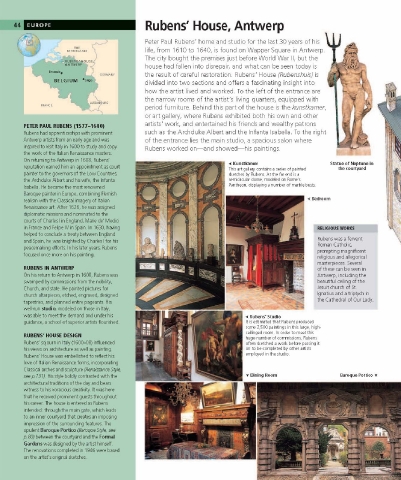
                                                     period furniture.  Behind  this part of the house is  the kunstkamer,
                                                     or art gallery, where Rubens exhibited both  his own and other
                                                     artists' work, and  entertained his  friends and wealthy patrons
         PETER PAUL RUBENS (1577-1640)
         Rubens had apprenticeships With prominent   such as  the Archduke Albert and the Infanta Isabella.  To  the right
         Antvverp artists from an early age and was   of the entrance lies the main studio, a spacious salon where
         inspired to visit Italy in  1600 to study and copy   Rubens worked on-and showed-his paintings.
         the work of the ltali an Renaissance masters.
         On returning to Antvverp in 1608, Rubens'
                                                                                  < Kunstkamer                         Statue of Neptune in
         reputation earned him an appointment as court
                                                                                  This art gallery contains a series of painted   the courtyard
         painter to the governors of the Low Countries,                           sketches by Rubens. At the far end is a
         the Archduke Jl.lbert and his wife, the Infanta                          semicircular dome, modeled on Rome's
                                                                                  Pantheon, displaying a number of marble busts.
         Isabella. He became the most renowned
         Baroque painter in Europe, combining Flemish
         realism with the Classical imagery of Italian                                                         <Bedroom
         Renaissance art. After 162 6, he was assigned
         diplomatic missions and nominated to the
         courts of Charles I in England, Marie de' Medici
         in France and Felipe IV in Spain.ln 1630, having                                                         RELIGIOUS WORKS
         helped to conclude a treaty betvveen England
                                                                                                                  Rubens was a fervent
         and Spain, he was knighted by Charles I for his
                                                                                                                  Roman Catholic,
         peacemaking efforts. In his later years, Rubens
                                                                                                                  prompting magnificent
         focused once more on his painting.
                                                                                                                  religious and allegorical
                                                                                                                  masterpieces. Several
         RUBENS IN ANTWERP                                                                                        of these can be seen in
         On his return to Antvverp in 1608, Rubens was                                                            Antwerp, including the
         swamped by commissions from the nobility,                                                                beautiful ceiling of the
         Church, and state. He painted pictures for                                                               Jesuit church of St.
         church altarpieces, etched, engraved, designed                                                           Ignatius and a triptych in
                                                                                                                  the Cathedral of Our Lady.
         tapestries, and planned entire pageants. His
         well-run studio, modeled on those in Italy,
         was able to meet the demand and under his                                      <  Rubens' Studio
         guidance, a school of superior artists flourished.                             It is estimated that Rubens produced
                                                                                        some 2,500 paintings in this large, high-
                                                                                        ceilinged room. In order to meet this
         RUBENS' HOUSE DESIGN
                                                                                        huge number of commissions, Rubens
         Rubens' sojourn in Italy (1600-08) influenced                                  often sketched a work before passing it
         his views on architecture as well as painting.                                 on  to be completed by other artists
                                                                                        employed in the studio.
         Rubens' House was embellished to reflect his
         love of Italian Renaissance forms, incorporating
         Classical arches and sculpture (RenaissanceS tyle,
         see p.131)  His style boldly contrasted with the                                v Dining Room                    Baroque Portico v
         architectural traditions of the day and bears
         witness to his voracious creativity. It was here
         that he received prominent guests throughout
         his career. The house is entered as Rubens
         intended  through the main gate, which leads
         to an inner courtyard that creates an imposing
         impression of the surrounding features. The
         opulent Baroque Portico (Baroque Style, see
         p.80) betvveen the courtyard and the Formal
         Gardens was designed by the artist him self.
          The renovations completed in 1946 were based
         on the artist's ori gina I sketches.

